
Zapier vs. Wissly: Which AI Automation Approach Fits Your Enterprise?
Compare Zapier and Wissly for enterprise automation. Learn when to use cross-app workflows and when to unify internal knowledge for AI search, analysis, and report generation.

Enterprise automation is not a one-size-fits-all challenge.
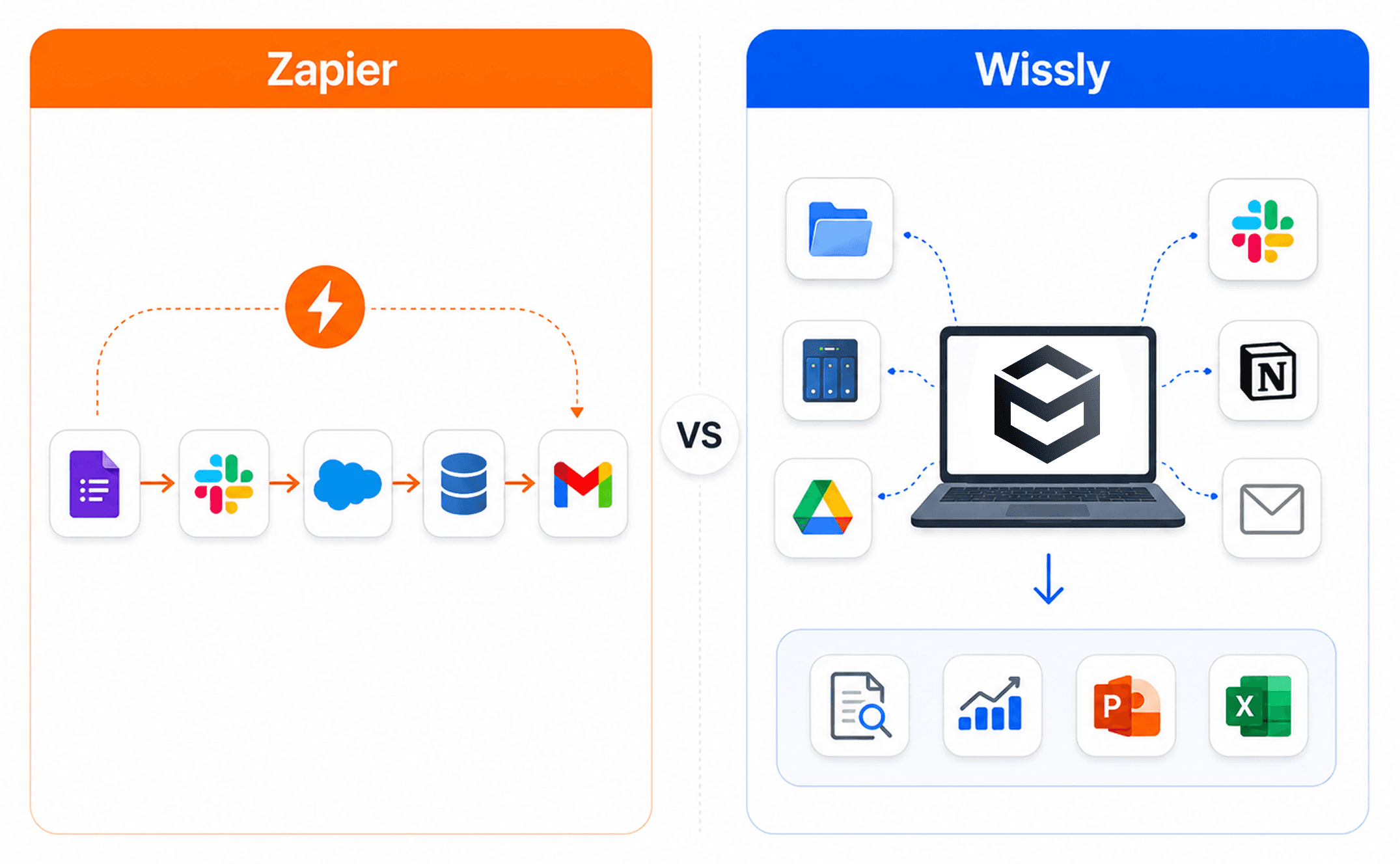
Some organizations need to automate repeatable actions across cloud applications. Others need to search, compare, and synthesize knowledge scattered across local folders, shared drives, NAS environments, Slack, Notion, and email.
Zapier is built for workflow execution-triggering actions across connected applications. Wissly is built for knowledge synthesis-turning approved internal data into searchable context, analysis, and review-ready business outputs such as presentations, financial summaries, and executive reports.
The right approach depends on whether your main bottleneck is application workflows or fragmented organizational knowledge.
📊 Not sure where your bottleneck lies? [Take our 5-Minute AI Automation Assessment] or jump to the [Deep Dive Comparison Below ↓].
-
Executive Summary: Zapier vs. Wissly at a Glance
For a technical assessment of both platforms, evaluate how they process enterprise data and generate business value:
<table><tbody><tr><td><p dir="ltr"><strong>Feature / Metric</strong></p></td><td><p dir="ltr"><strong>Zapier</strong></p></td><td><p dir="ltr"></p></td></tr><tr><td><p dir="ltr"><strong>Core Objective</strong></p></td><td><p dir="ltr">Cross-app workflow automation & task orchestration</p></td><td><p dir="ltr">Internal knowledge search, semantic analysis, and automated report generation</p></td></tr><tr><td><p dir="ltr"><strong>Primary Mechanism</strong></p></td><td><p dir="ltr">Trigger-and-action linear logic & AI-powered app APIs</p></td><td><p dir="ltr">Natural-language querying (RAG) across approved enterprise data sources</p></td></tr><tr><td><p dir="ltr"><strong>Typical Data Sources</strong></p></td><td><p dir="ltr">Cloud SaaS apps, Public APIs, Webhooks, CRM platforms</p></td><td><p dir="ltr">Local folders, NAS, shared drives, Slack threads, Notion pages, Emails</p></td></tr><tr><td><p dir="ltr"><strong>Typical Outcomes</strong></p></td><td><p dir="ltr">Automated alerts, CRM record updates, cross-system data synchronization</p></td><td><p dir="ltr">Contextual search results, executive summaries, PPT slides, Excel reporting sheets</p></td></tr><tr><td><p dir="ltr"><strong>Best Suited For</strong></p></td><td><p dir="ltr">Deterministic, repeatable workflows across cloud-native business apps</p></td><td><p dir="ltr">Cross-referencing disparate documents, legacy files, and communication context</p></td></tr></tbody></table>-
Deep Dive: Architectural Differences & Core Use Cases
2-1. Zapier: Deterministic Data Pipelines & Workflow Orchestration
Zapier is the industry standard when your operational goal is to connect distinct SaaS applications through conditional logic: "If Event X occurs in App A, execute Action Y in App B."
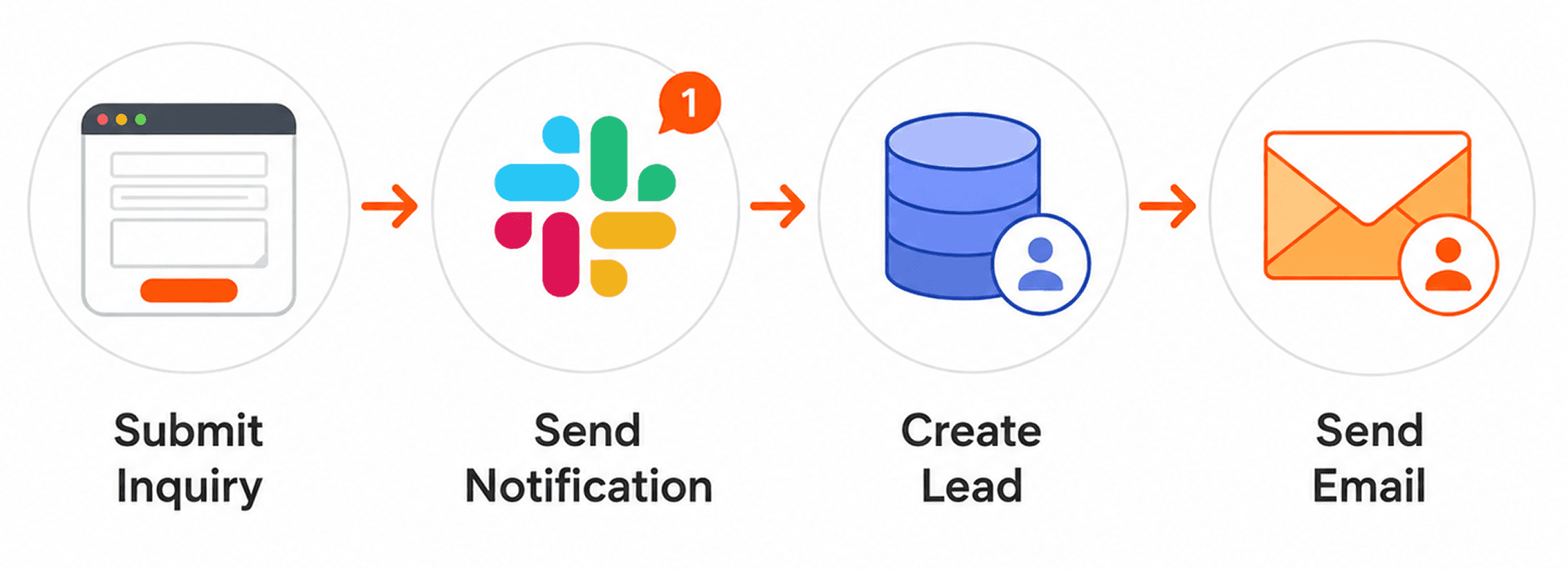
[Trigger: Form Submission] ➔ [Action 1: Update CRM] ➔ [Action 2: Notify Slack Team]
-
Enterprise Use Cases: Automating marketing tech stacks, routing sales leads, sync-loading customer support tickets, or managing linear workflows built around structured database events.
-
The AI Capabilities: While Zapier offers AI-related workflow capabilities and autonomous agent features, its fundamental value remains centered on orchestrating actions across external cloud APIs.
2-2. Wissly: Cognitive Knowledge Synthesis & Generative Output Pipelines
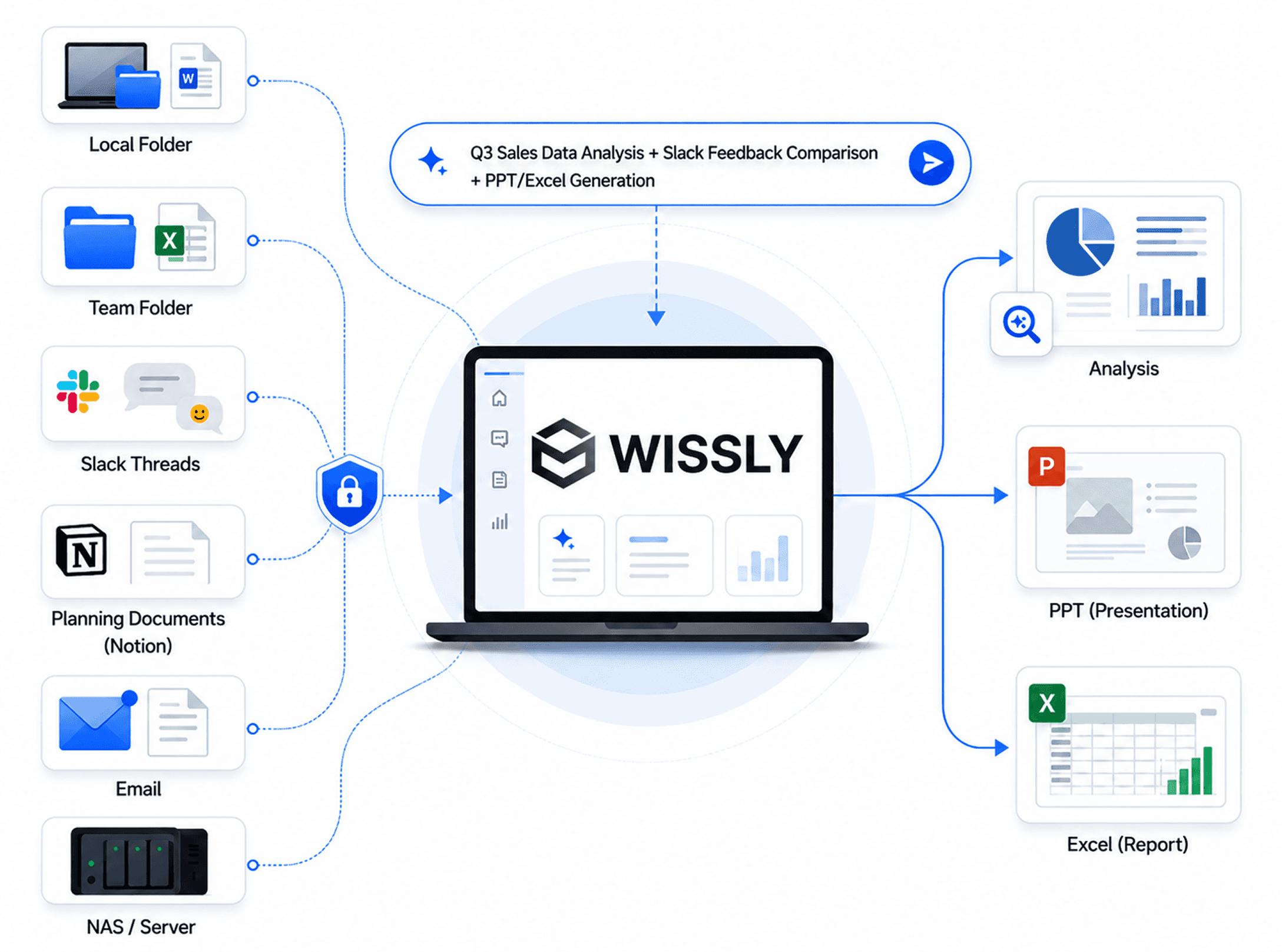
Wissly addresses the challenge of "dark data"-the unstructured, critical business context buried deep within your on-premise infrastructure, local machines, communication channels, and document silos. Instead of just moving data from point A to point B, Wissly synthesizes it.
-
Semantic Querying: Instead of building rigid workflows, users interact with Wissly using natural language to solve complex data challenges:
-
"Analyze the Q3 sales spreadsheet in our team folder, compare it with customer feedback in Slack and planning criteria in Notion, then prepare a five-slide executive presentation draft and an Excel summary."
-
Context-Aware Report Generation: Wissly retrieves relevant, approved enterprise sources, maps the contextual relationships between different file formats (PPT, PDF, Word, Excel, HWP, CSV), and compiles them into ready-to-present enterprise intelligence.
Note: Available integrations, security models, deployment approaches (such as On-Premise or Private Cloud), and precise output formats are tailored based on each enterprise’s specific IT infrastructure and compliance scope.
-
Collaborative Synergy: Can Zapier and Wissly Coexist?
Yes. The two platforms are highly complementary layers of a modern enterprise AI stack.
Zapier automates the front-end movement of structured data and operational events across external web applications. Wissly acts as the cognitive layer, allowing teams to search, analyze, and report on the massive amounts of unstructured documents and conversations that naturally accumulate across internal knowledge bases.
-
Zapier executes workflows across application ecosystems.
-
Wissly extracts insights from fragmented enterprise knowledge to generate business assets.
-
Architectural Roadmap: Choosing the Right Automation Layer
-
Deploy Zapier if: Your priority is orchestrating repeatable, event-driven actions across SaaS tools, forms, CRM systems, cloud databases, and standard messaging APIs.
-
Deploy Wissly if: Your priority is connecting siloed enterprise knowledge across local folders, NAS, shared drives, Slack, Notion, and email-then using that consolidated intelligence to automate deep analysis and report creation.
-
Frequently Asked Questions
Frequently Asked Questions
-
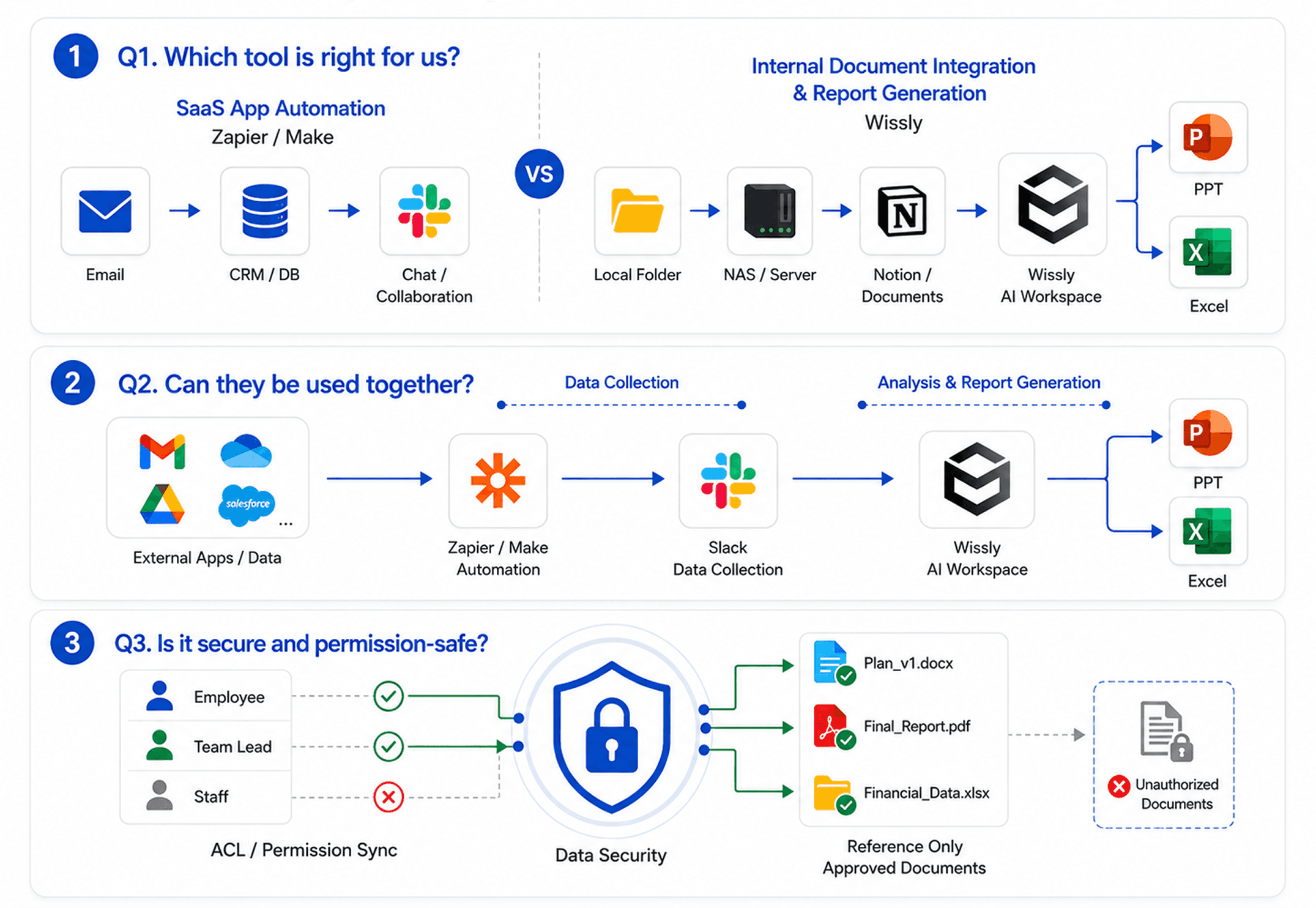
Q1. Which tool is right for us?
-
Choose Zapier or Make for repeatable SaaS workflows. Choose Wissly to search and analyze internal documents, chats, and files for reports and business outputs.
-
Q2. Can Zapier and Wissly work together?
-
Yes. Zapier can automate app workflows, while Wissly can analyze approved internal knowledge and generate report drafts.
-
Q3. How are permissions handled?
-
Wissly can be configured around approved data sources, user permissions, and deployment requirements. Users should only access information they are authorized to view.
⚙️ Evaluate Your Enterprise Infrastructure
Determine whether your organization needs automated data movement or unified knowledge synthesis. Get expert architectural guidance today:
-
📊 [Apply for a Customized AI Automation Technical Assessment →]
-
🛠️ [Schedule an On-Premise Data Integration and PoC Consultation →]
Related Articles
-
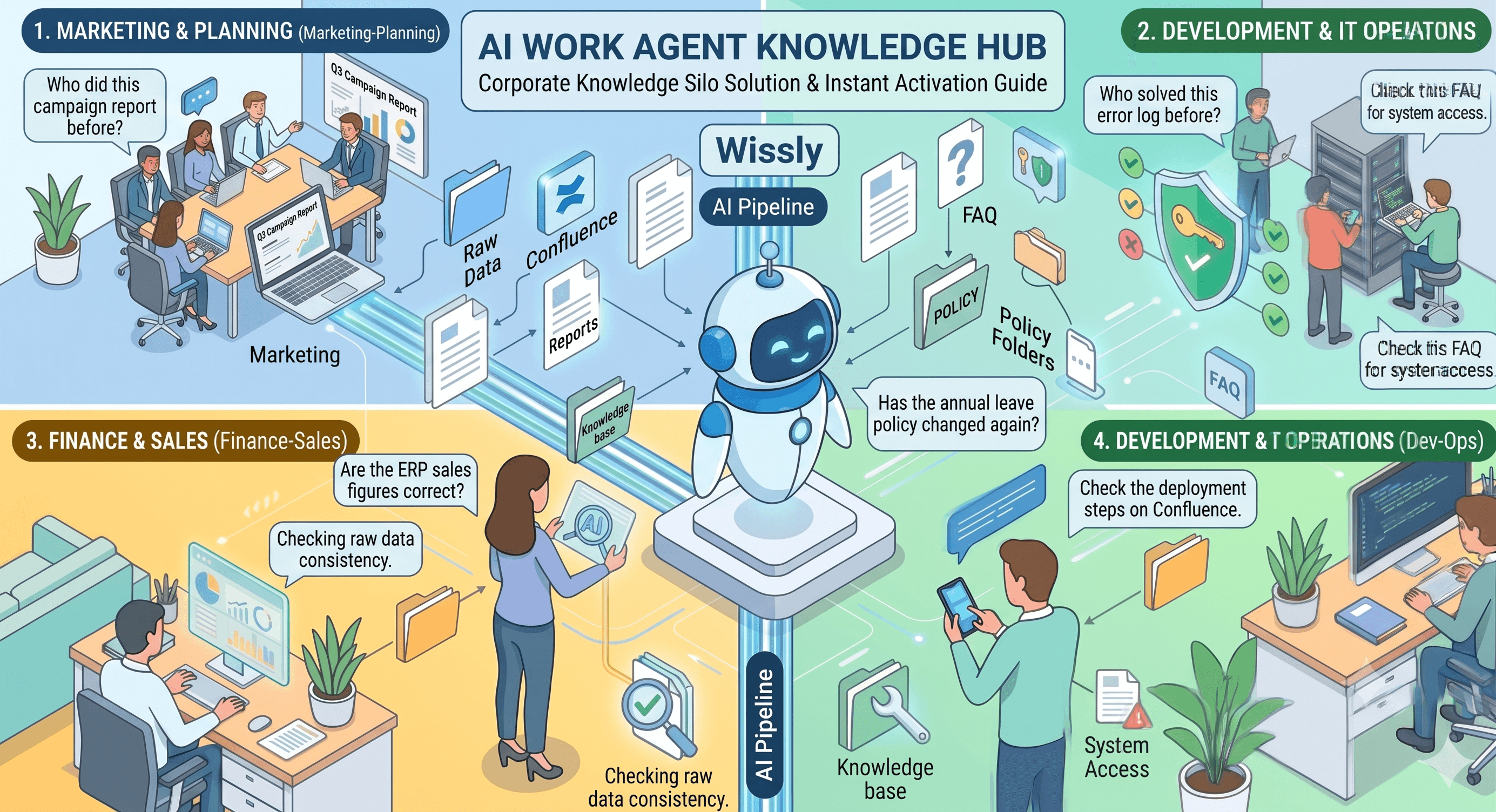
"Where Is Last Quarter's Campaign Report?"
-
"Did the PTO Policy Change Again?"
-
"Are These ERP Revenue Numbers Accurate?"
-
"Has Anyone Solved This Error Before?"