
Insight
Enterprise KMS Guide: How to Build an AI RAG Knowledge Base


Executive Summary
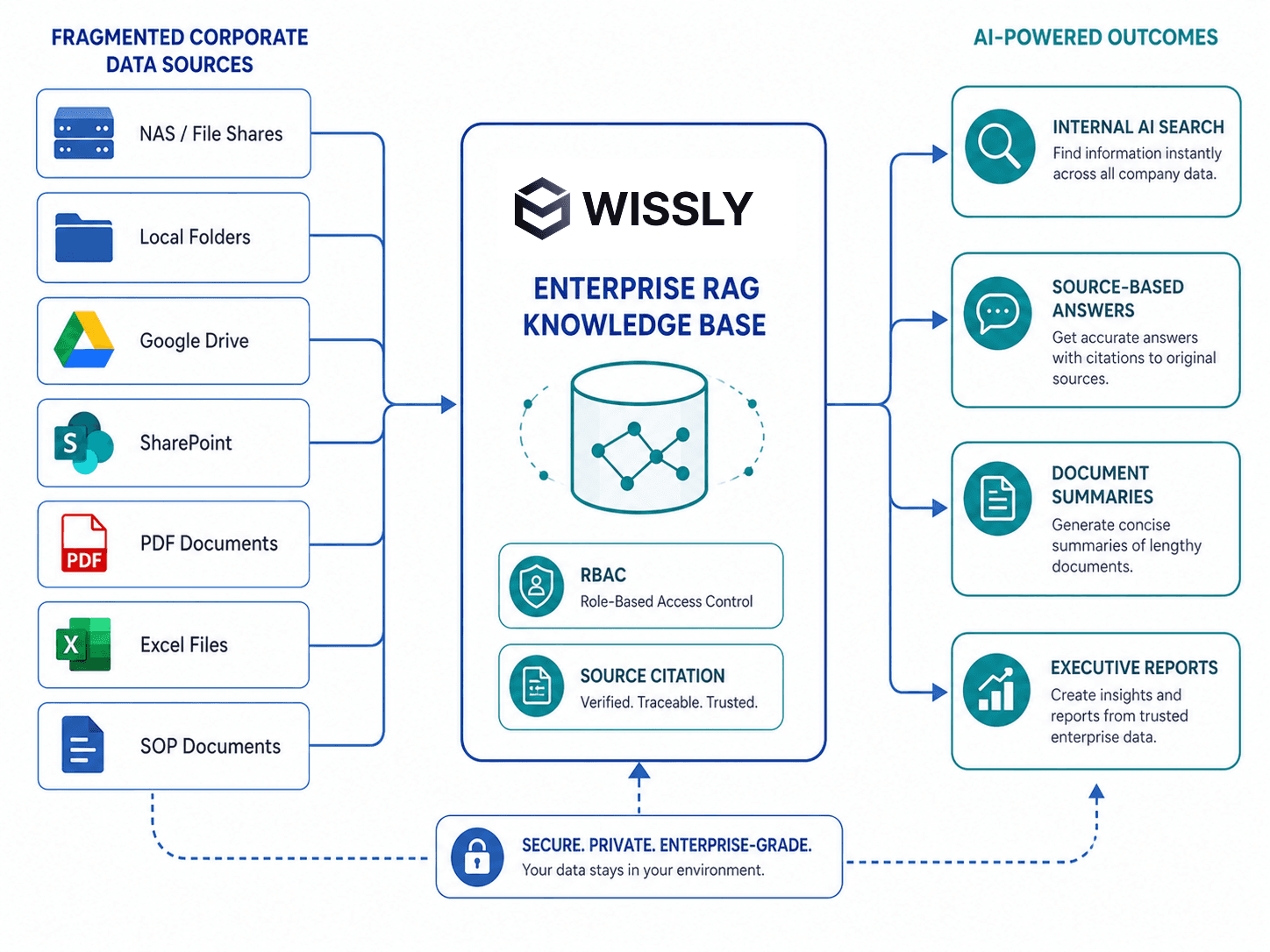
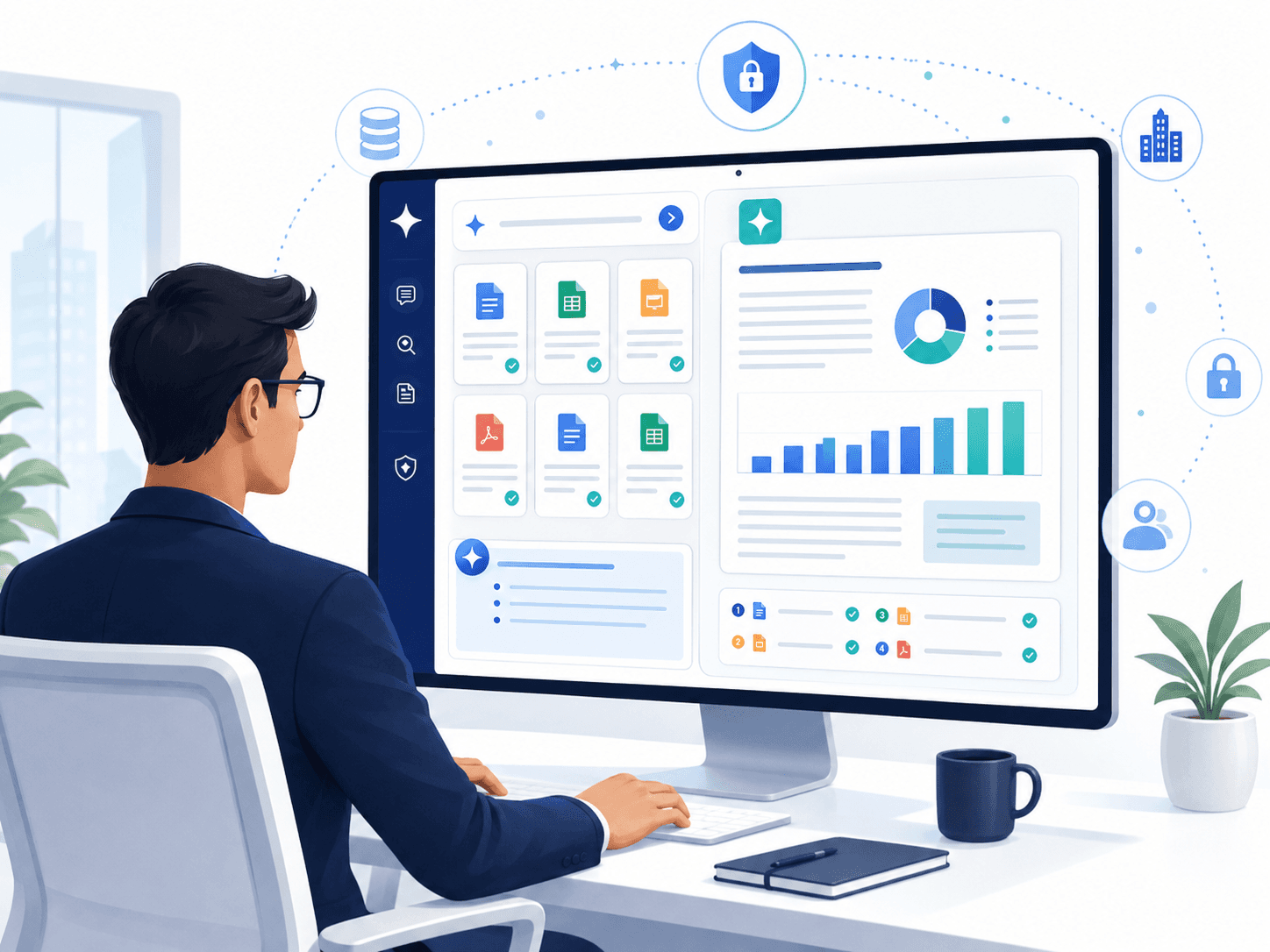
An Enterprise Knowledge Management System (KMS) centralizes fragmented corporate files into an actionable intelligence hub. However, building a custom RAG (Retrieval-Augmented Generation) infrastructure in-house demands extensive engineering bandwidth, complex OCR/data parsing, fine-grained access control (RBAC), and ongoing LLM infrastructure overhead.
Wissly offers a streamlined, deployment-ready alternative. By seamlessly connecting to your existing storage—such as local folders, NAS, and Google Drive—Wissly deploys an enterprise-grade RAG knowledge base without the heavy burden of custom development.
[Evaluate Wissly for Your Enterprise Environment →]
Why Building an Internal KMS In-House Is Harder Than Expected
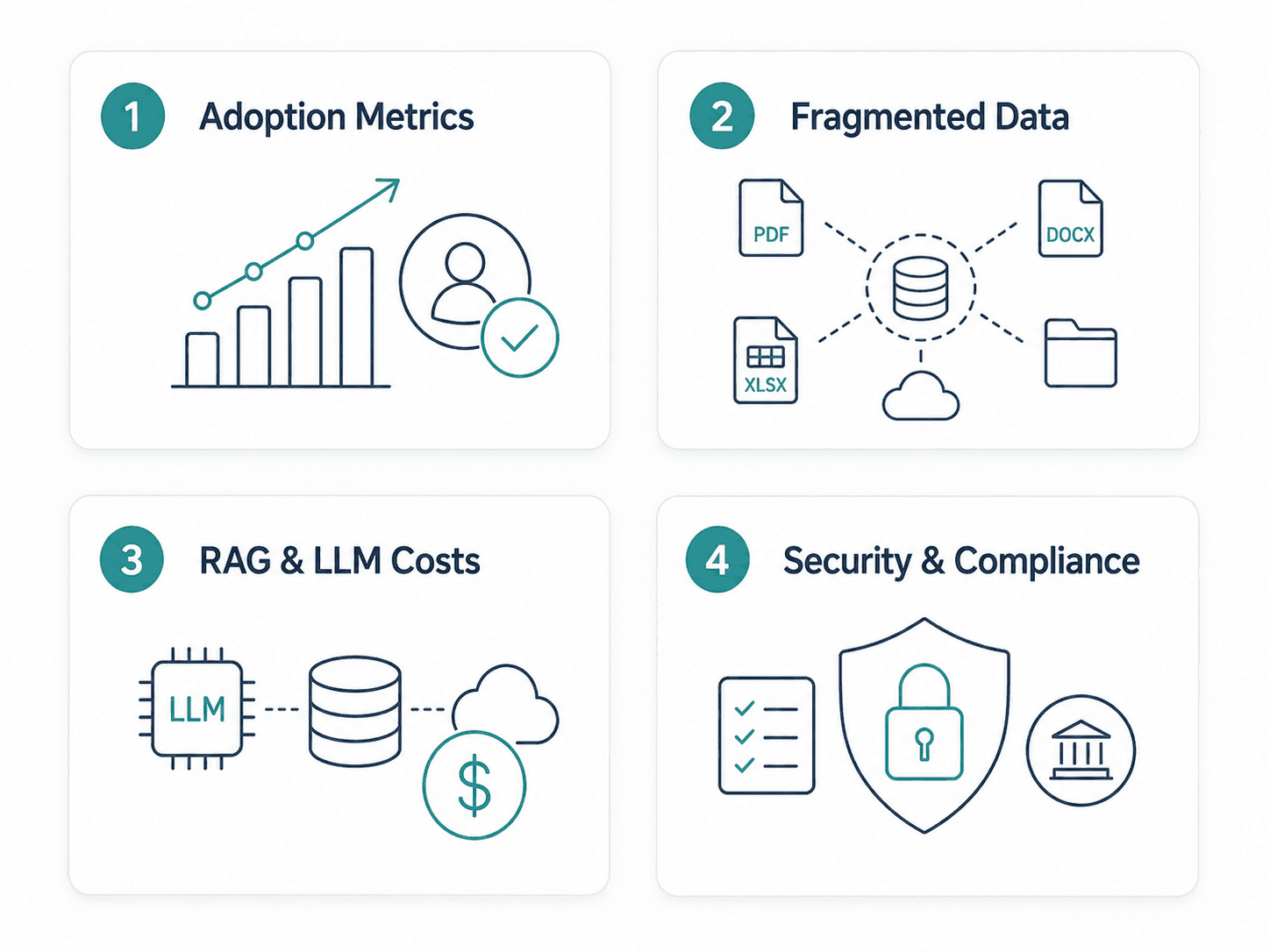
Organizations naturally want a unified search engine for internal documents, SOPs, and project archives. However, internal engineering teams often face major friction points when building a custom KMS from scratch:
Unmeasurable Impact & Adoption Metrics: Tracking ROI, employee usage rates, and search precision after deployment is notoriously difficult to quantify.
Unstructured & Fragmented Data Standards: File formats, naming conventions, and storage locations vary widely across departments, making data cleaning labor-intensive.
Compounding RAG & LLM Infrastructure Costs: Vector database maintenance, document embedding pipelines, and LLM API usage incur unpredictable, recurring expenses.
Strict Security & Compliance Barriers: Enterprise requirements—such as Role-Based Access Control (RBAC), air-gapped deployments, and strictly regulated on-premise constraints—substantially increase engineering complexity.
What Is a Modern Enterprise KMS?
An Enterprise Knowledge Management System (KMS) is a framework for capturing, storing, and retrieving corporate intelligence.
While traditional KMS tools functioned merely as static file repositories, modern platforms combine RAG, Large Language Models (LLMs), semantic search, and permission-aware retrieval. Today’s KMS is no longer just a digital filing cabinet—it is an interactive AI knowledge platform that answers complex queries, synthesizes data, and accelerates daily workflows.
The 3 Core Technical Bottlenecks of Custom In-House RAG
Building an in-house RAG infrastructure presents three distinct technical hurdles:
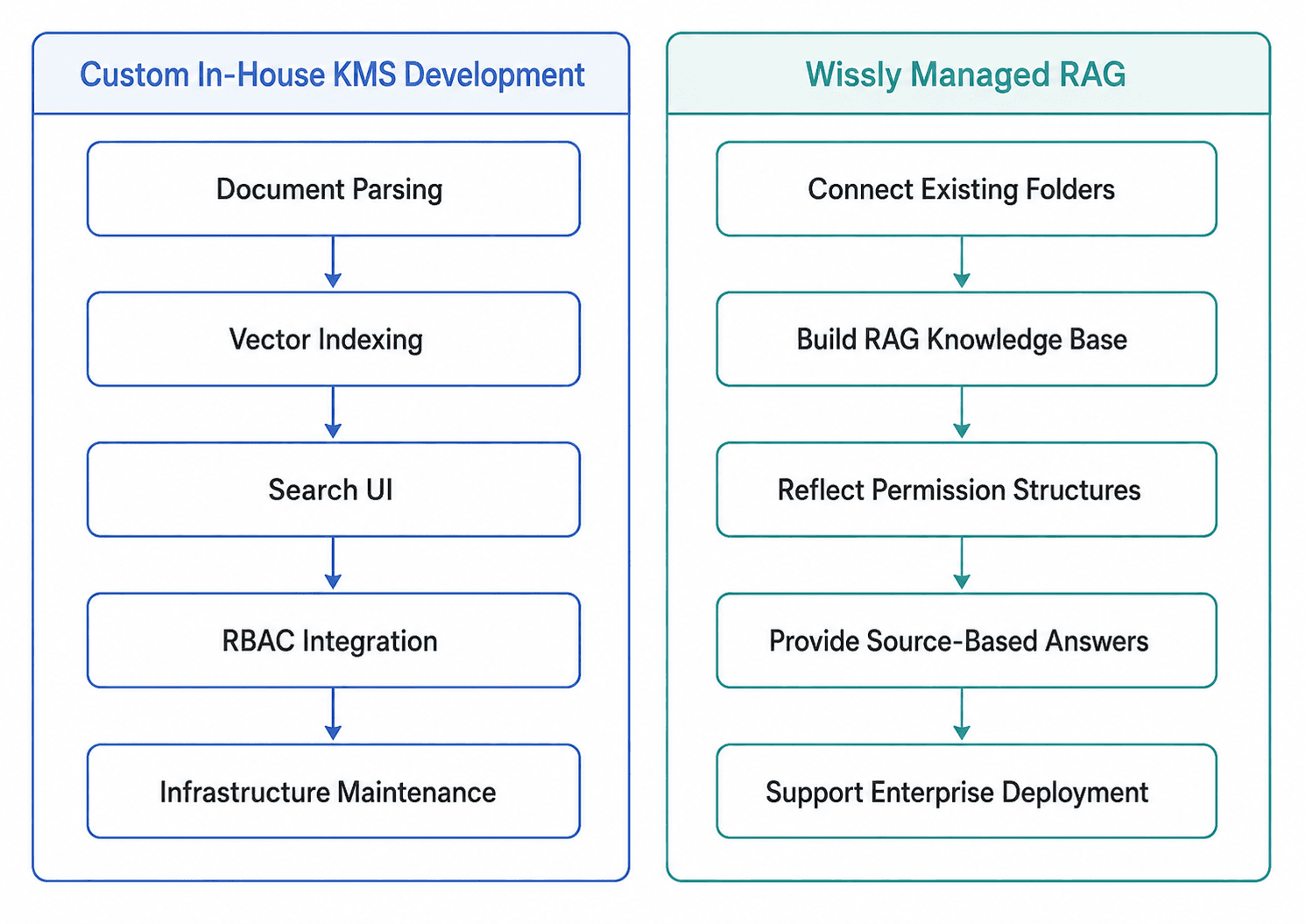
Complex Document Parsing & Multimodal Extraction: Processing complex PDFs, HWP files, scanned images, Excel tables, and PowerPoint decks requires advanced OCR, layout parsing, and metadata structuring.
Granular Access Control (ACL/RBAC): Integrating existing Active Directory (AD), SSO, NAS permissions, and document-level Access Control Lists into a vector search engine is significantly more complex than standard keyword search.
Continuous Maintenance & Pipeline Optimization: In-house teams must permanently own vector index updates, permission syncs, hallucination monitoring, and infrastructure scaling.
Custom In-House KMS vs. Wissly Managed RAG
Key Feature | 🛠️ Custom In-House Development | 🚀 Wissly AI Folder-Integrated RAG |
Deployment Approach | Custom code for parsing, indexing, UI, and security | Direct connection to existing file systems/storage |
Implementation Time | Months of active engineering sprints | Rapid setup for initial test environments |
Engineering Resources | Requires dedicated AI, Backend, Frontend & Security engineers | Low-code folder integration minimizes dev overhead |
Access Control (RBAC) | Custom integration for AD, SSO, and file-level ACLs | Inherits existing NAS and shared folder permission structures |
Security Architecture | Manual setup of local LLMs, air-gapped networks, or VPCs | Support for On-Premise, Air-Gapped & Hybrid deployments |
OpEx & Maintenance | Unpredictable ongoing dev, server, Vector DB, and API costs | Predictable subscription or enterprise pricing models |
How Wissly Accelerates Enterprise Knowledge Deployment
Wissly transforms existing corporate data repositories into an active intelligence network without requiring infrastructure overhauls.
Leverage Existing Storage Architectures: Connect directly to local drives, NAS servers, Google Drive, or cloud storage without disruptive data migration.
Fact-Based RAG Answers with Source Citation: Answers are dynamically generated using your enterprise documents as ground truth, accompanied by direct source attribution for full auditability.
Security & Permission-Aware Search: Helps ensure users retrieve answers from documents they are explicitly authorized to view.
Enterprise Security (On-Premise & Air-Gapped): Offers private cloud, air-gapped, and on-premise deployment configurations to comply with strict data sovereignty regulations.
Pre-Implementation Checklist for IT & Security Leaders
Before deciding between custom engineering or a specialized RAG solution, evaluate these six factors:
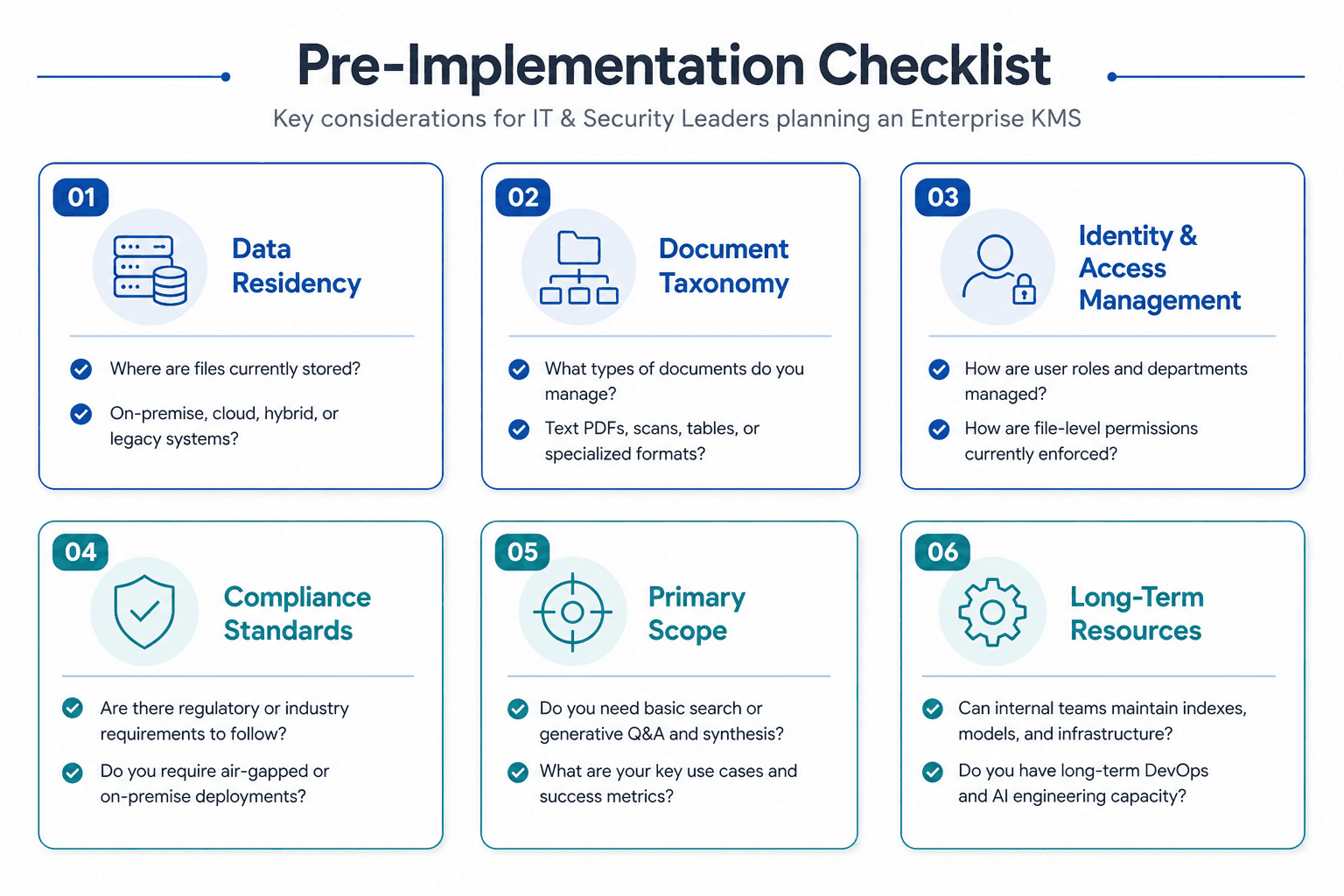
Data Residency: Are files stored in local NAS, cloud drives, SharePoint, or legacy file servers?
Document Taxonomy: What is the ratio of searchable text PDFs versus scanned documents, tables, or specialized formats?
Identity & Access Management: How are user roles, departmental access, and file-level permissions currently governed?
Compliance Standards: Do security protocols require strictly air-gapped or on-premise hosting?
Primary Scope: Do you need basic search, or full generative Q&A, synthesis, and executive reporting capabilities?
Long-Term Resource Availability: Can internal DevOps and AI engineers permanently maintain vector indexes, security patches, and model updates?
Frequently Asked Questions (FAQ)
Q1. Can we deploy an enterprise RAG knowledge base without a dedicated AI engineering team?
In many cases, yes. Wissly can reduce the need for manual LLM fine-tuning or custom pipeline architecture, while IT teams still define security policies, access scope, and deployment requirements.
Q2. Can the system scale to handle tens of thousands of large enterprise documents?
Yes. Wissly is designed for enterprise-scale document environments, with indexing architectures that support large repositories, source attribution, and efficient retrieval depending on document volume, permissions, and infrastructure conditions.
Q3. Does the solution respect existing NAS and directory permissions?
Yes. Wissly integrates with your existing security infrastructure (NAS ACLs, AD/SSO), helping ensure the AI retrieves and generates responses only from documents the requesting user is authorized to access.
Q4. How does an AI RAG Knowledge Base differ from a traditional KMS?
Traditional KMS platforms require manual tag-based indexing and return lists of documents. A RAG-powered knowledge base dynamically searches contextually relevant passages, synthesizes concise answers, and links directly to verified source citations.
8. Conclusion: Shift from File Retrieval to Actionable Intelligence
Building an enterprise KMS from scratch consumes significant engineering resources, time, and budget. Instead of rebuilding parsing engines and vector storage, modern enterprises choose deployment-ready RAG solutions that connect directly to their data.
Accelerate your organization's transition to AI-driven knowledge management without inflating your engineering backlog.
[Assess Your Enterprise RAG Readiness with Wissly →]
[Schedule an On-Premise & Enterprise Security Demo →]
🔗 Related Resources
Recommended Content