
Maritime AI Architecture: Why Data Sovereignty Is the Real Competitive Edge
Maritime AI competitiveness depends on data sovereignty. Learn how shipping lines can use Enterprise RAG, HITL validation, and hybrid infrastructure to build secure AI.

The competitive advantage of Maritime AI does not come from simply adopting the largest Large Language Model. For shipping lines, the real advantage lies in how securely and effectively they can turn proprietary domain data into AI-ready knowledge assets.
Charter parties, maintenance logs, vessel drawings, PMS records, ERP data, class inspection reports, and internal emails contain operational intelligence that generic AI models cannot understand on their own.
In this third installment of the Maritime AI series, we explore the architecture required to build a secure, enterprise-grade AI system for shipping companies, focusing on data assetization, Enterprise RAG, domain-specific tuning, expert validation, and secure infrastructure models.
-
Part 1 Review: We discussed the risk of "Shadow AI," where employees use public AI tools with sensitive internal data.
-
Part 2 Review: We covered practical short-term PoC opportunities such as decarbonization compliance, Noon Report validation, and technical document search.
Now the key question is: “What architecture is required to build a secure AI co-pilot tailored to our own fleet and internal operations?”
The answer does not start with the model. It starts with your data.
-
Data Assetization: Turning Maritime Documents Into AI-Ready Assets
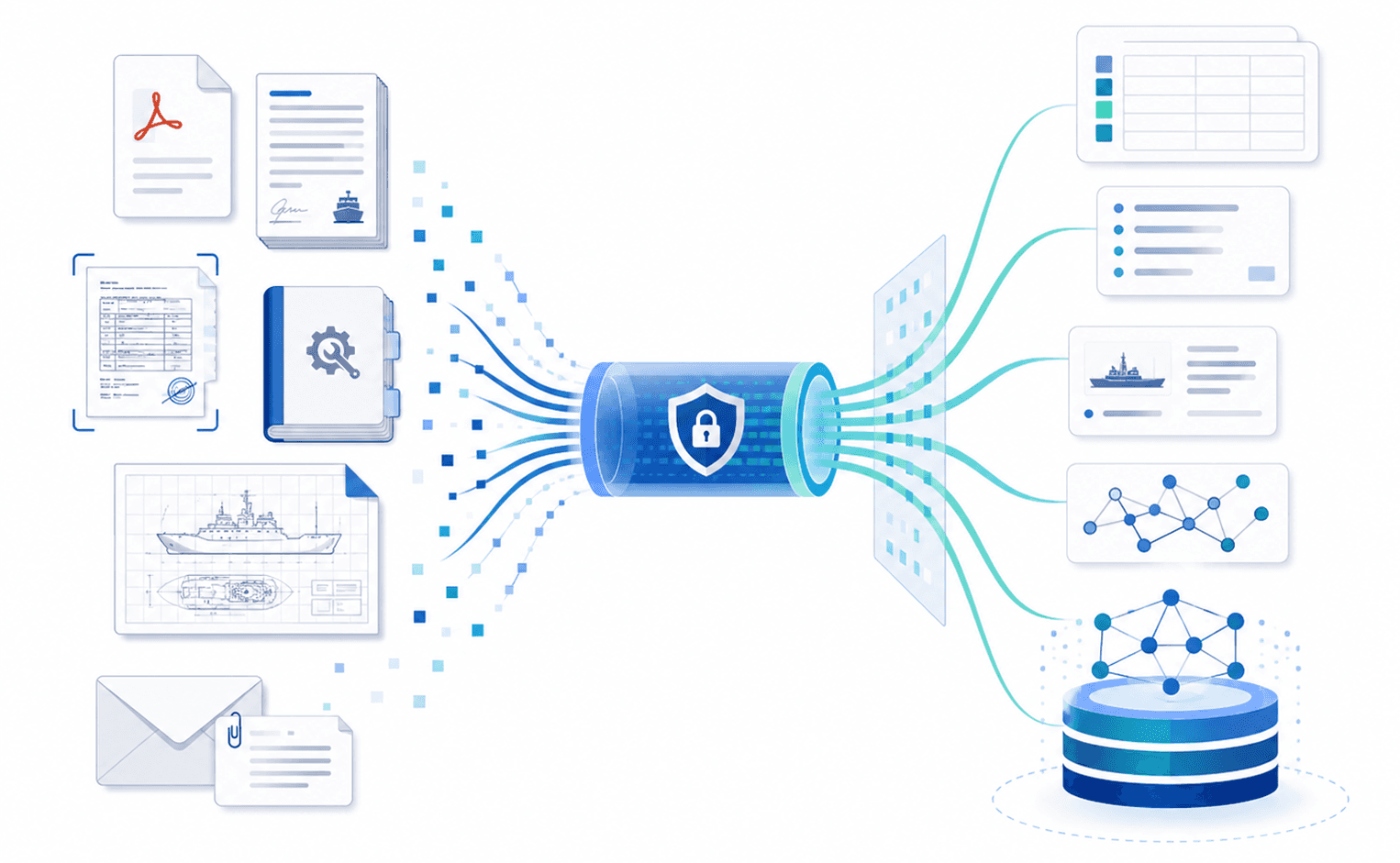
Successful Maritime AI depends less on sophisticated algorithms and more on high-quality data preprocessing and indexing. Most of a shipping company’s operational knowledge is locked inside unstructured formats: PDF charter parties, scanned class inspection reports, technical manuals with complex tables, vessel drawings, email attachments, and siloed PMS or ERP records.
To make this knowledge usable by AI, companies must convert fragmented documents into structured, searchable, and permission-aware data assets:
-
Intelligent Document Parsing: This process extracts meaning from complex maritime documents without losing important structure. Standard OCR is rarely enough. Maritime documents contain tables, clauses, vessel codes, engineering terminology, and scanned layouts that must be preserved accurately.
-
Hybrid Vector Indexing: This allows AI systems to understand both keywords and semantic meaning. Because maritime operations rely on specialized terminology, equipment codes, and company-specific abbreviations, a technical superintendent must be able to find documents that are contextually relevant to an issue, not just exact keyword matches.
Data assetization is the foundation of maritime AI competitiveness. A shipping line that organizes, secures, and searches its proprietary knowledge will have a stronger AI foundation than a competitor relying only on general-purpose models.
-
The Phased Technology Stack: From Enterprise RAG to Action Agents
Building a maritime AI system should not begin with full-scale model training or expensive custom LLM development. A more realistic path is a phased architecture:
[Phase 1: Enterprise RAG] ➔ [Phase 2: CPT/SFT Domain Tuning] ➔ [Phase 3: VLM & Action Agents]
[Phase 1: Enterprise RAG] ➔ [Phase 2: CPT/SFT Domain Tuning] ➔ [Phase 3: VLM & Action Agents]
[Phase 1: Enterprise RAG] ➔ [Phase 2: CPT/SFT Domain Tuning] ➔ [Phase 3: VLM & Action Agents]
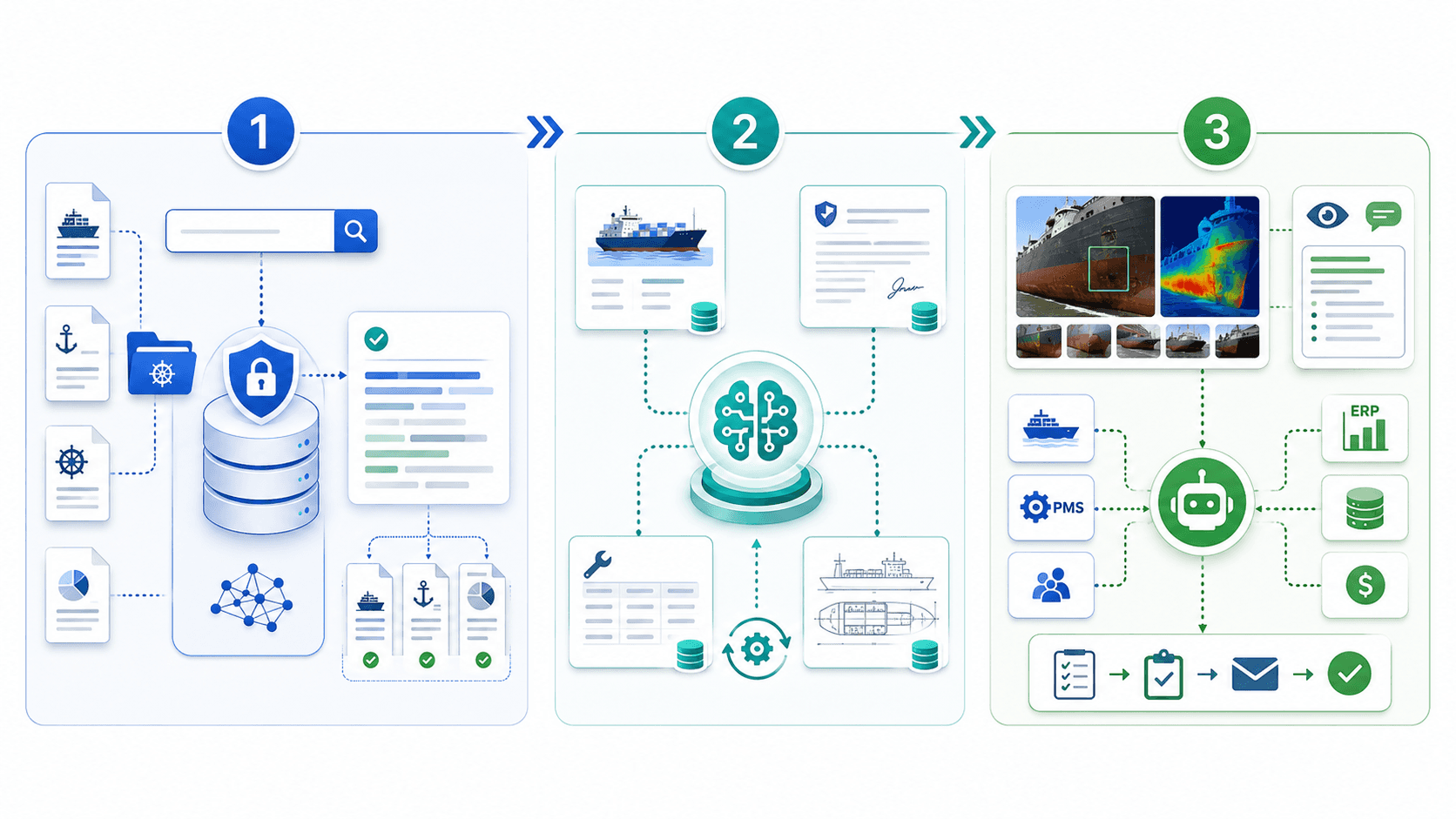
Phase 1: Enterprise RAG (Retrieval-Augmented Generation)
Enterprise RAG allows an AI system to search internal documents first and then generate answers based on verified sources.
For shipping lines, this is the most practical starting point. Without training a new model from scratch, the organization can connect charter parties, technical manuals, regulatory documents, PMS logs, inspection reports, and internal policies.
The most important feature of Enterprise RAG is source traceability. When an AI answer includes references to the original document, page, clause, or paragraph, human operators can review the evidence before using it in real work. This drastically reduces hallucination risk and improves operational trust.
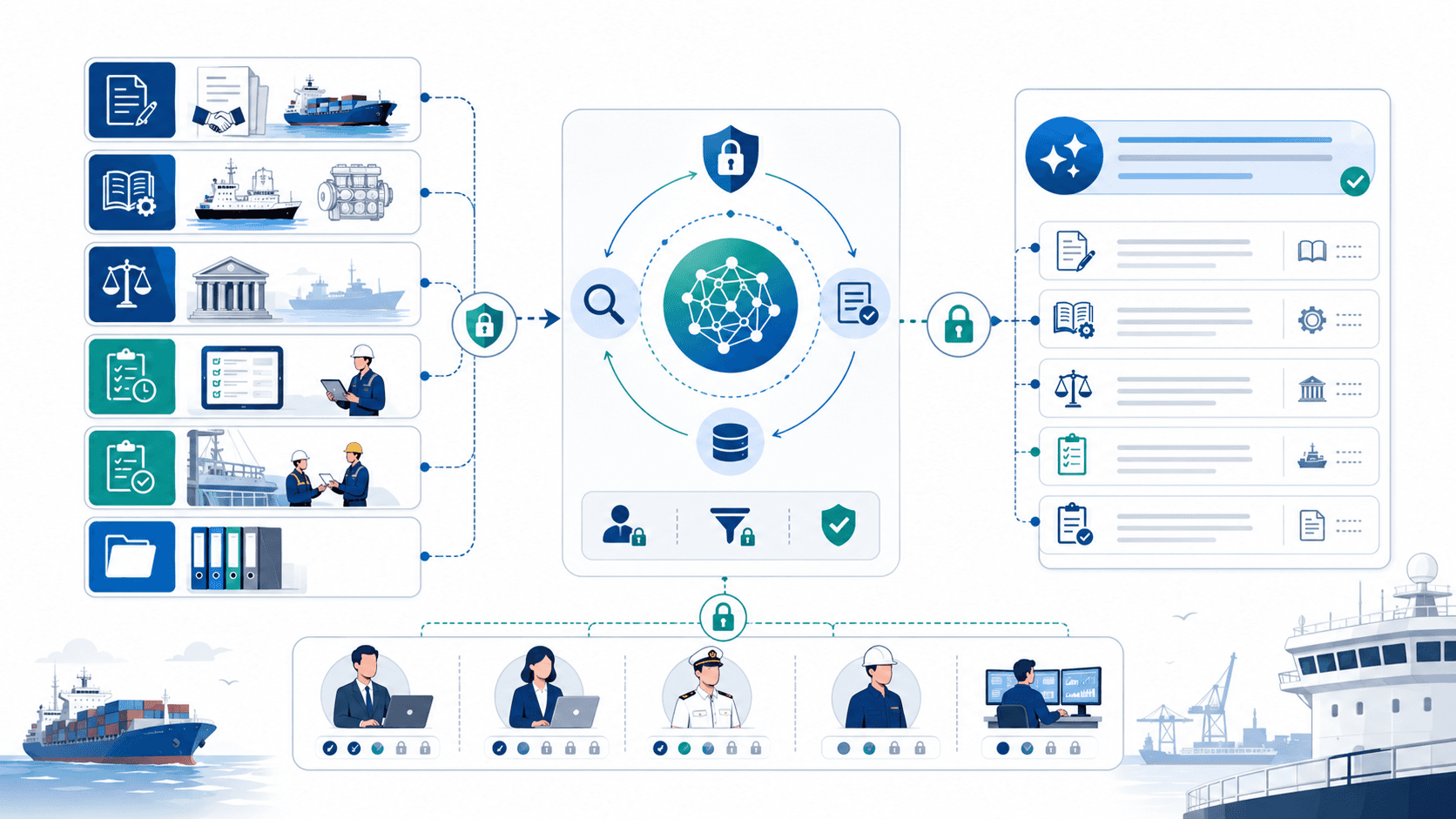
- Phase 1 Objective: Securely connect internal data sources, enforce Role-Based Access Control (RBAC), and provide grounded answers with verifiable source references.
Phase 2: CPT and SFT Domain Tuning
Once the RAG environment is stable, shipping companies can consider domain-specific tuning:
-
CPT (Continual Pre-Training): Helps the model better understand maritime language, company-specific document styles, regulatory wording, technical terminology, and operational patterns.
-
SFT (Supervised Fine-Tuning): Trains the model on curated question-and-answer examples that reflect actual company workflows.
This phase is useful for specialized tasks such as charter party clause comparison, maritime regulatory interpretation, maintenance risk assessment, and claims document classification. However, this step should not come too early. CPT and SFT require clean data, evaluation datasets, and clear business use cases. It is safer to validate business value through Enterprise RAG first and move into domain tuning once usage patterns mature.
Phase 3: VLM and Action Agents
The third phase expands Maritime AI beyond text:
-
VLM (Vision-Language Models): Processes visual information such as hull corrosion photos, drone inspection footage, scanned drawings, blueprints, and structural images to support automated vessel condition reviews.
-
Action Agents: Goes one step further by creating draft actions inside connected business systems. For example, a superintendent may ask: "Based on the latest maintenance history and replacement cycle, generate a draft work order for the next inspection." An AI agent can then prepare that draft directly inside the PMS or ERP system.
This stage has strong potential but requires strict governance. No operational action should be executed without proper human review, authorization, and audit logging.
-
Human-in-the-Loop Validation
In maritime operations, AI errors are not minor inconveniences. A wrong interpretation of a demurrage clause can create legal exposure. An incorrect maintenance recommendation can affect vessel safety. A misleading compliance summary can create regulatory risk.
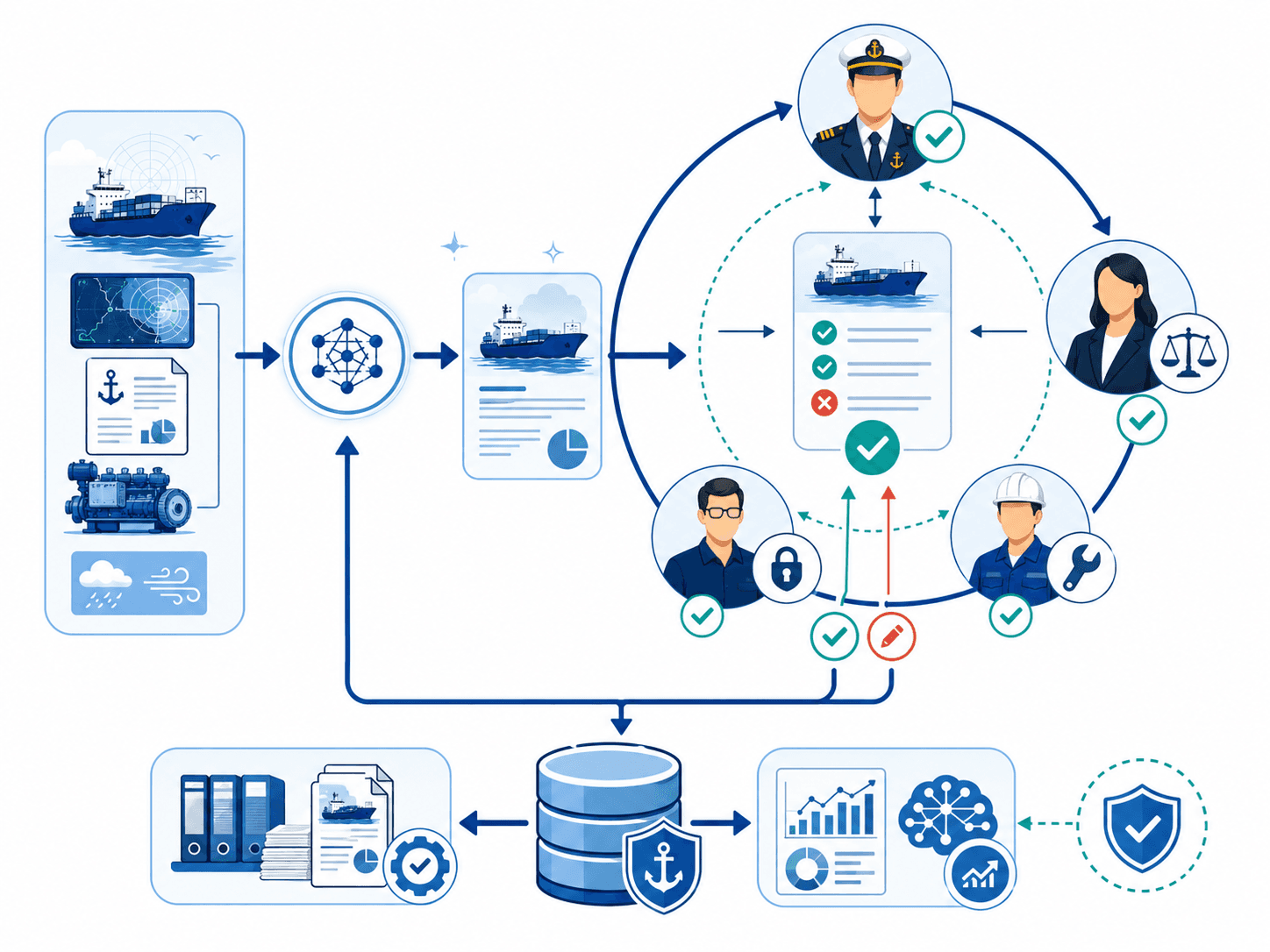
This is why Maritime AI must include a Human-in-the-Loop (HITL) validation framework. AI should generate the first answer or draft, but domain experts must review, correct, and approve critical outputs.
These experts may include master mariners, chief engineers, technical superintendents, legal counsel, compliance teams, and IT security leaders. Their feedback should be captured as evaluation data so the system can improve over time. The goal is not to replace maritime experts, but to help them work faster, review more evidence, and make better decisions with reliable access to internal knowledge.
-
Secure On-Premise and Hybrid Infrastructure
To reduce Shadow AI risk and protect proprietary knowledge, shipping companies need infrastructure that matches their data sensitivity.
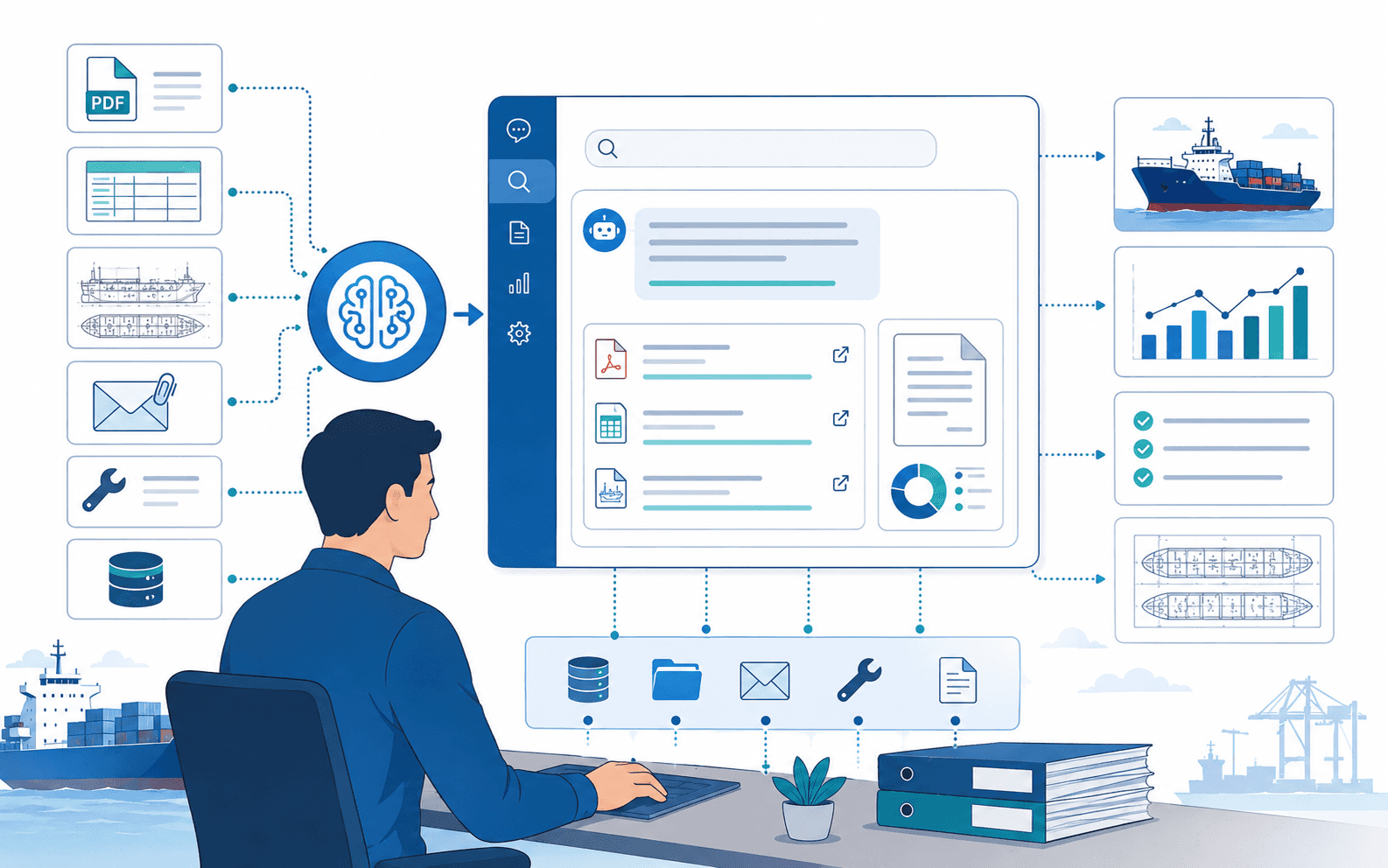
Many maritime organizations handle sensitive chartering data, vessel performance records, maintenance histories, financial data, and internal operational reports. Sending all of this data to a multi-tenant public cloud may not align with internal security policies or compliance requirements. Two deployment models are especially relevant:
-
On-Premise Infrastructure: Runs AI systems on internal servers or closed network environments. This model is suitable for highly sensitive data because it minimizes external data movement and supports tighter internal control.
-
Hybrid Infrastructure: Combines internal data processing with secure private cloud resources. Sensitive data can remain inside the company environment, while selected compute-heavy workloads run in controlled private cloud infrastructure.
The right architecture depends on the organization’s data classification, security requirements, compliance obligations, and operational goals. The key is to define which data can be processed where, who can access it, and how every AI output can be audited.
-
Conclusion: Maritime AI Competitiveness Depends on Data Sovereignty
The future of Maritime AI will not be determined only by which company uses the newest model. It will be determined by which shipping lines can secure, structure, and operationalize their proprietary data. Contracts, vessel drawings, PMS records, inspection reports, maintenance histories, ERP data, and internal decision records are not just documents-they are competitive assets.
A strong Maritime AI strategy should begin with data assetization, move into Enterprise RAG, expand into domain-specific tuning, and eventually support VLM and action-agent workflows under strong human governance. The core of Maritime AI is not the model itself; it is the ability to turn company-owned data into a secure, searchable, and actionable knowledge foundation.
Accelerate Your Secure Maritime AI PoC With Wissly
Wissly is an enterprise AI knowledge collaboration platform designed to connect fragmented internal data and turn it into practical business outputs.
For maritime organizations, Wissly supports PoC environments that connect local folders, NAS, PMS, ERP, email, technical manuals, contracts, inspection reports, and operational documents. With Role-Based Access Control and source-based answers, teams can test AI use cases without replacing the entire enterprise system from day one.
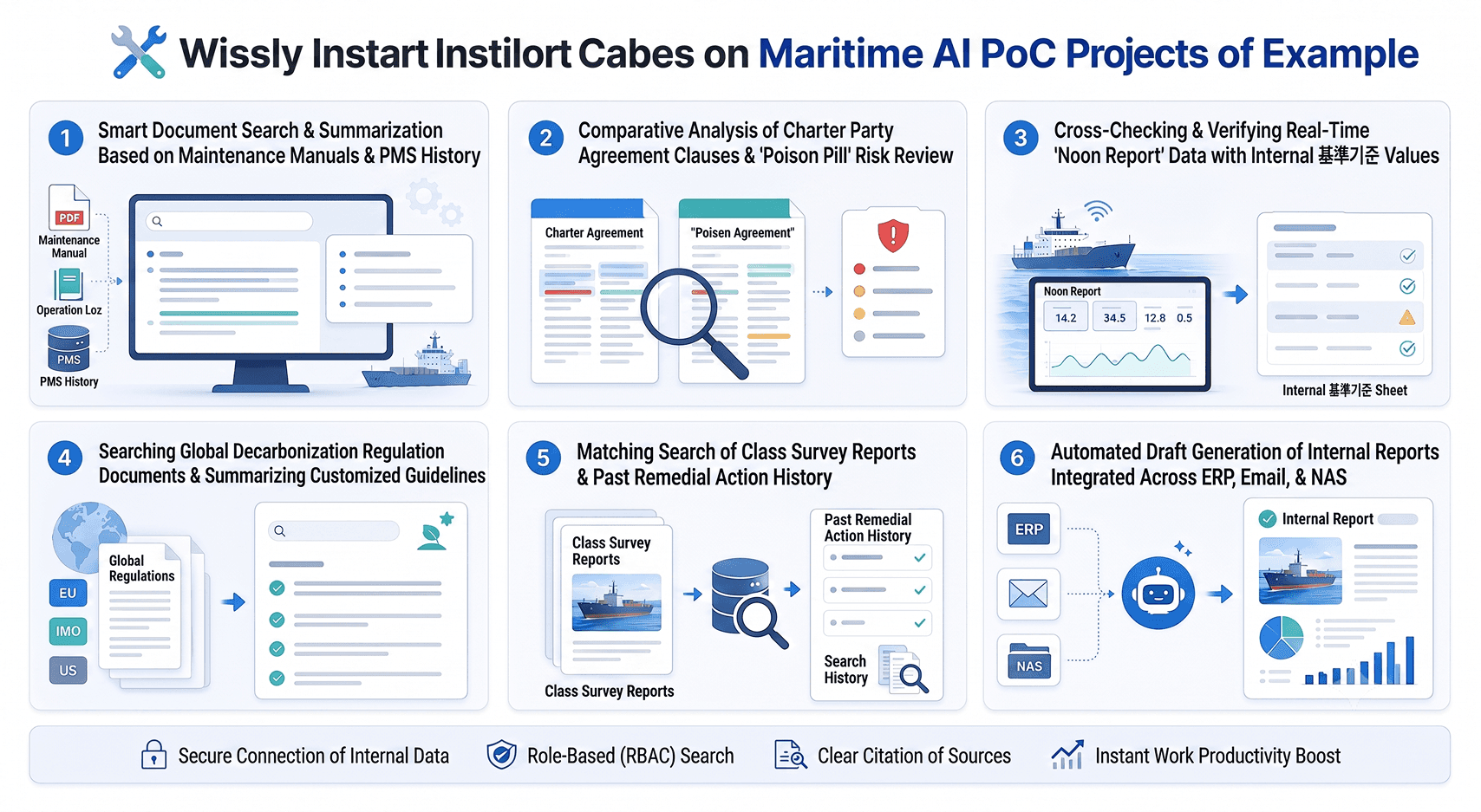
A Maritime AI PoC does not need to start with a massive infrastructure project. It can begin with a focused operational problem. Examples include:
-
Smart technical manual search across maintenance documents and PMS logs
-
Charter party clause comparison and risk review
-
Noon Report validation against internal performance baselines
-
Decarbonization regulation search and fleet-specific summary generation
-
Class inspection report search with historical corrective action matching
-
Internal report draft generation based on ERP, email, NAS, and document data
If your shipping company wants to protect data sovereignty while validating practical AI use cases, Wissly can help design a secure, focused Maritime AI PoC roadmap.
(Note: Integration scope, deployment model, access control design, and data processing conditions may vary depending on each customer’s system environment, security policy, and implementation requirements.)


