
Insight
ISO 9001:2026 Compliance Strategy: Solving ‘Data Debt’ with Internal AI Chatbot


ISO 9001:2026 Transition: More Than Just a Certificate Renewal
The ISO 9001:2026 revision, the first in 11 years, is becoming a ‘litmus test for digital transformation’ for global maritime and manufacturing enterprises. The reinforced risk management and real-time response frameworks require a level of precision that traditional analog methods can no longer sustain.
In the process of adapting to these new regulations, many companies are facing critical operational bottlenecks:
Fragmentation of Knowledge: Discrepancies between headquarters' latest guidelines and legacy manuals at field sites (ships/plants) lead to fatal decision-making errors.
Compliance Uncertainty: When auditors ask, "How is the revised risk clause reflected in your field SOPs?" failing to provide immediate evidence puts your certification at risk.
Inefficient Resource Drain: Quality and safety experts are buried in the "manual labor" of cross-checking tens of thousands of documents, preventing them from focusing on strategic improvements.
Ultimately, this chaos stems from the fact that vast amounts of corporate documentation remain as unmanageable 'Data Debt' rather than accessible assets.

What is Data Debt?
"Data you cannot use is a liability, not an asset."
Data Debt refers to data that is accumulated on corporate servers but cannot be utilized for actual decision-making.
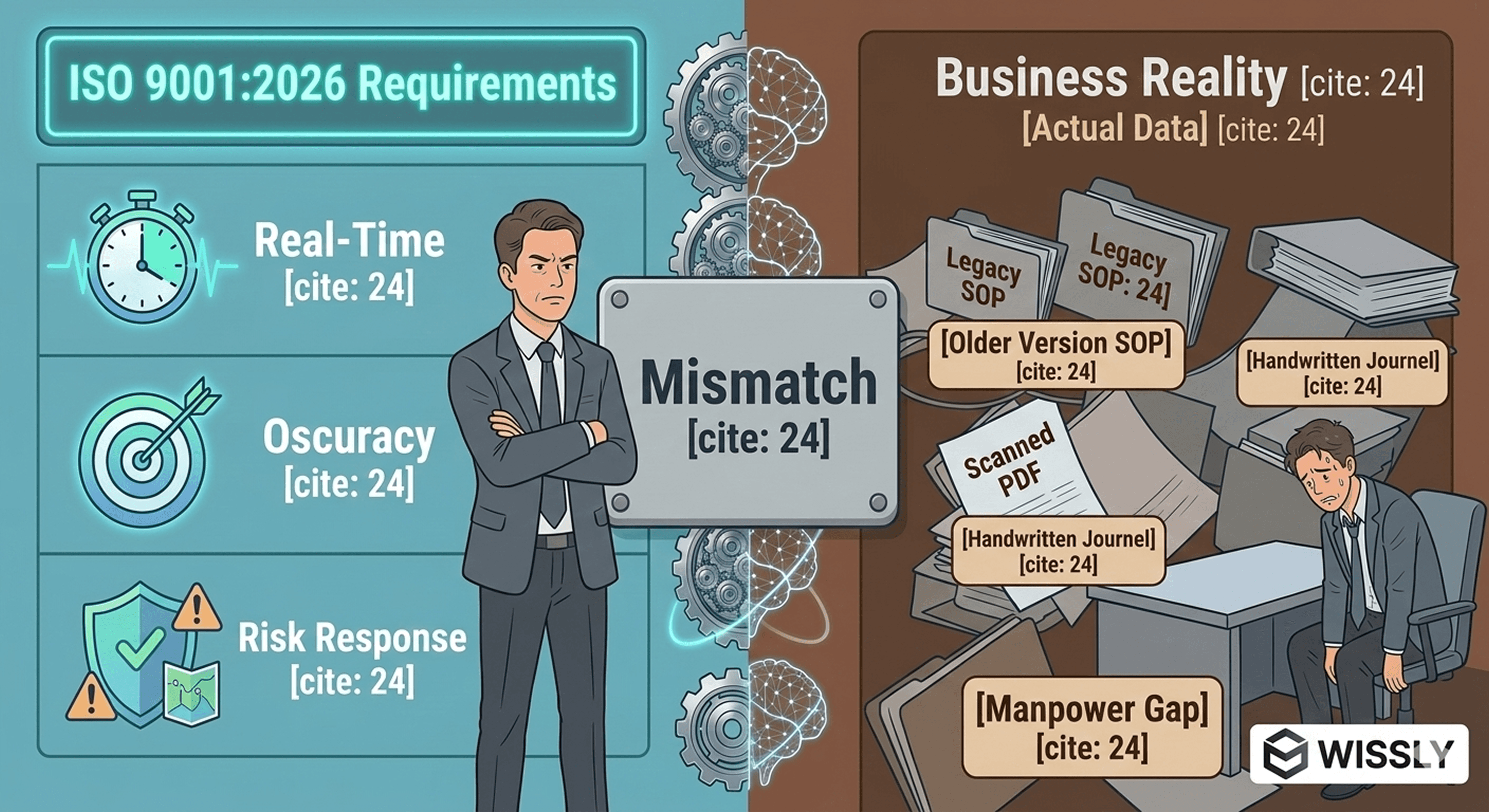
Thousands of scanned PDF manuals (Non-searchable)
Handwritten maintenance logs (Non-analyzable)
Outdated SOPs without version control
This data not only incurs storage costs but also acts as a decisive hindrance, slowing down the company's response during volatile regulatory shifts.
Why Traditional Methods Fail the ISO 9001:2026 Challenge
The core of ISO 9001:2026 is the shift from 'mere record-keeping' to 'Risk-based Real-time Response.' Existing analog-style data management simply cannot meet these requirements.
Limitations of Updates (Unstructured Data): To update manuals according to new rules, you need to reference past incident reports. However, most are 'unsearchable scans,' requiring months just for manual analysis.
Erosion of Trust (Contextual Loss): ISO 2026 strictly demands 'currency.' Current systems often mix 10-year-old rules with new ones. Field decisions based on outdated data are immediate grounds for audit failure.
Disruption of Knowledge Transfer (Aging Workforce): The experts capable of interpreting complex regulations are nearing retirement. With manuals spanning thousands of pages and the 'brains' to interpret them disappearing, this is the most lethal form of Data Debt.
Wissly Internal AI Chatbot: Turning Debt into Intelligence
Enterprises must shift their paradigm from simple document storage to an Internal AI Chatbot that understands context. Wissly, an On-premise RAG Chatbot, provides the following solutions:
Intelligent Full-scale Audit (RAG): Wissly learns thousands of internal documents in minutes and answers questions based on the most current regulations.
Robust Security (On-premise): Core blueprints and QMS know-how are the lifeblood of your company. Wissly runs in a secure On-premise environment, ensuring total data sovereignty.
Absolute Traceability: Eliminating AI hallucinations, Wissly provides the exact page and line number of the source PDF, allowing for instant verification.

[Q&A] Solving ISO 9001:2026 with Internal AI
Q1: We already have a Document Management System (DMS). Why do we need an AI Chatbot?
A1: Traditional systems only 'find files.' An Internal AI Chatbot acts as an 'Intelligent Assistant' that connects the content within thousands of files in real-time to tell you exactly what actions to take.
Q2: Does it take a long time to organize existing data for implementation?
A2: No. Wissly uses RAG (Retrieval-Augmented Generation) to learn directly from unstructured data (PDFs, scans). There is no need for manual data cleaning; it’s ready as soon as you upload your files.
[Next Step]
Recommended Content