
What Is an Enterprise AI Platform? A Practical Guide to AI Adoption
Learn what an Enterprise AI Platform is and how to choose the right architecture. Explore data silos, RBAC security, Enterprise RAG, hybrid deployment, and Work AI deliverables.

Executive Summary
An Enterprise AI Platform is an infrastructure-level operational system that securely connects fragmented corporate data, enforces Role-Based Access Control (RBAC), and transforms raw internal knowledge into actionable work deliverables (such as reports, slide decks, and spreadsheets).
Many enterprise AI initiatives struggle to move beyond the Proof-of-Concept (PoC) stage because of internal data silos, strict security barriers, and an over-reliance on basic document search. To drive measurable business value, enterprises must shift from simple conversational chatbots to unified Work AI environments.
Want to know which Enterprise AI architecture fits your data environment?
[Find Your Enterprise AI Architecture with Wissly →]
-
Why Do Many Enterprise AI Initiatives Struggle at the PoC Stage?
When enterprises begin their AI journey, executive attention naturally gravitates toward technical specs: purchasing GPU capacity, selecting foundation models, or building isolated PoCs. However, when these solutions reach frontline employees, three critical operational roadblocks frequently emerge:
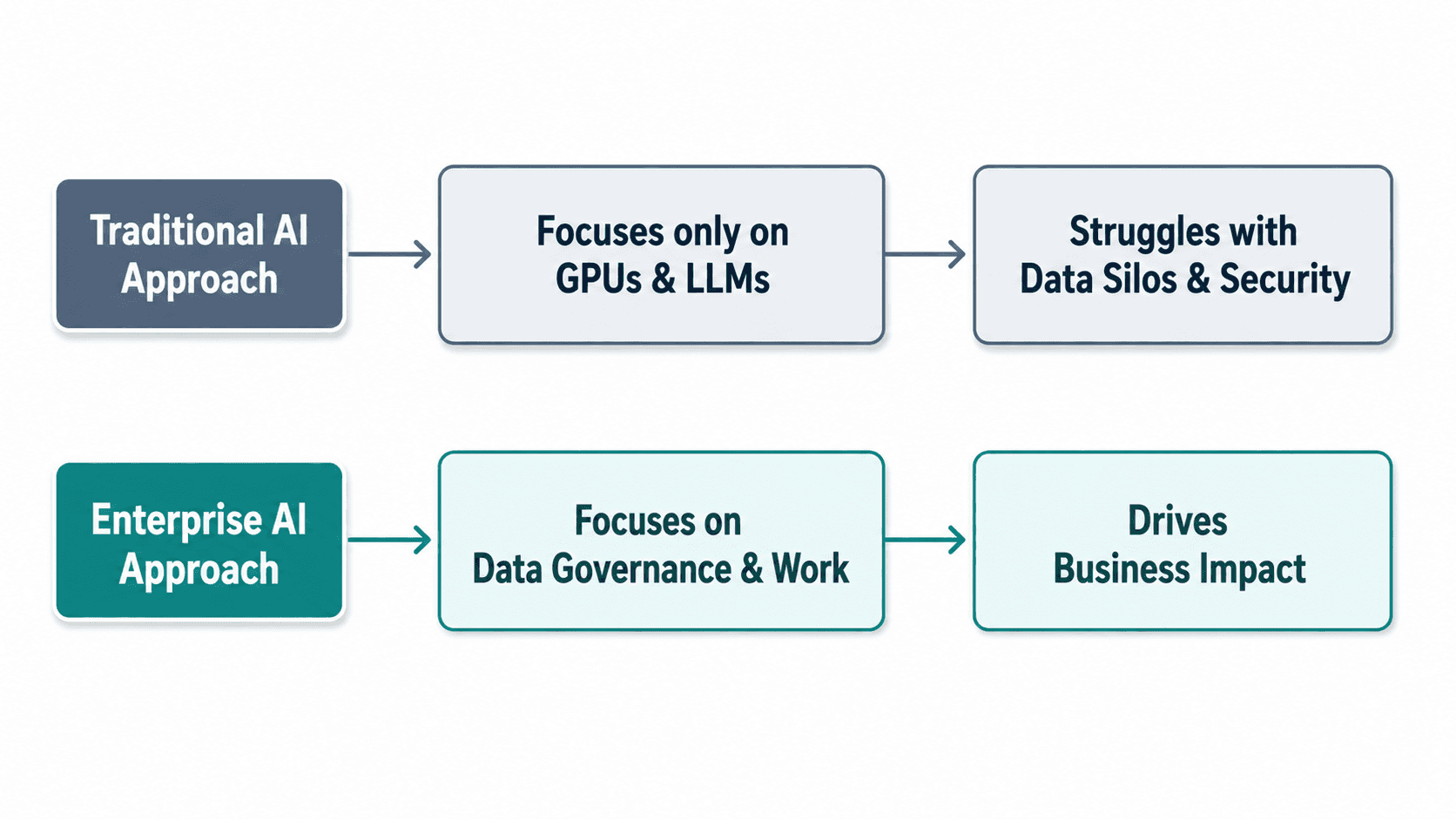
1-1. Chronic Data Fragmentation (Data Silos)
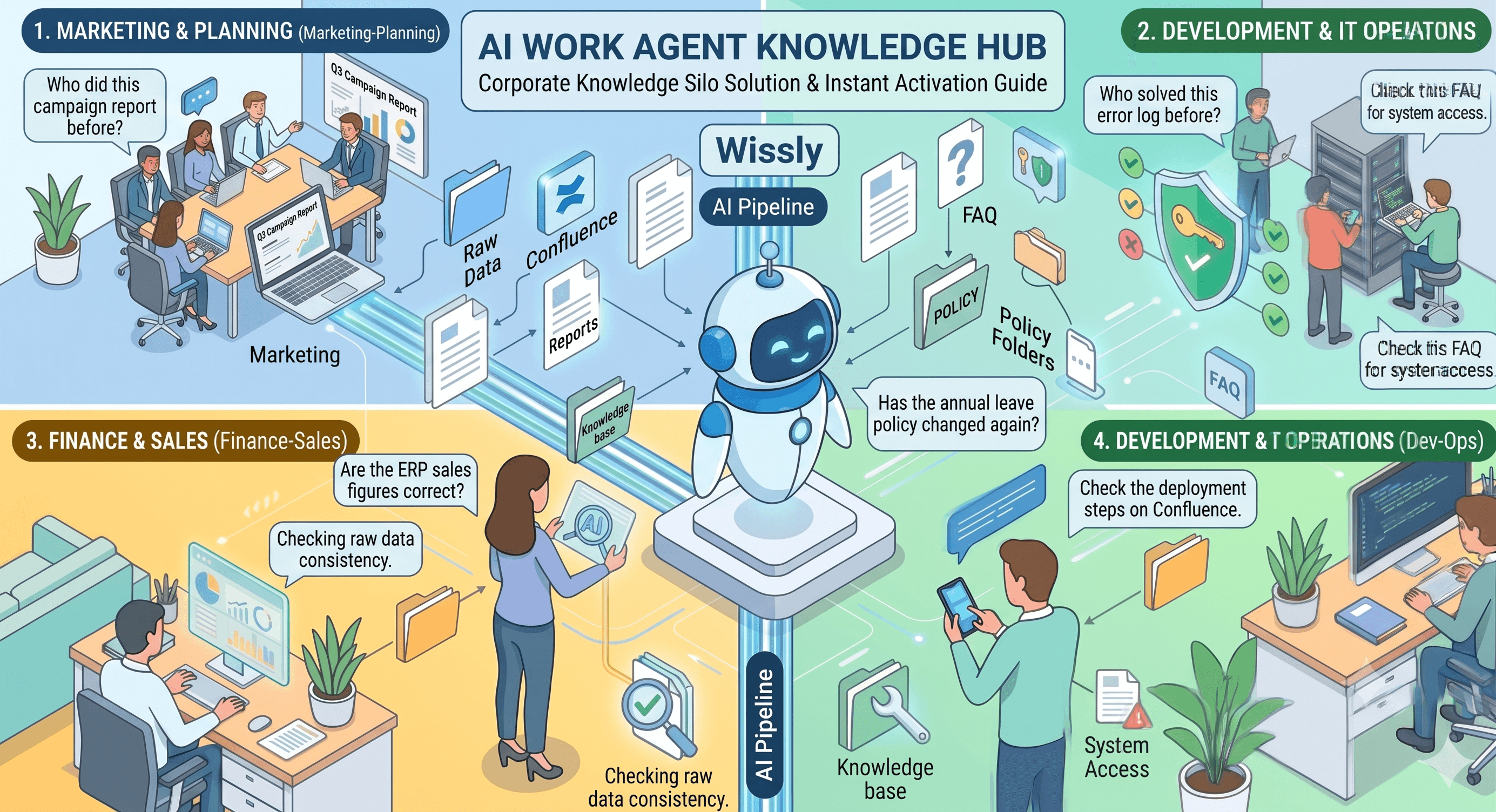
Enterprise knowledge rarely sits neatly inside modern SaaS tools like Slack or Notion. Critical domain knowledge is often scattered across local drives, legacy NAS, email servers, ERP systems, and secure document repositories. Standard AI models cannot easily access or parse these fragmented sources without structured integration.
1-2. Security and Regulatory Constraints
In regulated industries-such as finance, public sector, healthcare, and manufacturing-sending proprietary IP or sensitive data to public cloud AI services raises compliance concerns. Without secure private cloud, hybrid, or on-premise architectures, employees cannot leverage real-world operational data with AI.
1-3. The "Search Only" Bottleneck
Retrieving a document or generating a text summary is helpful, but it rarely completes a workflow. A financial analyst or HR manager still needs to synthesize that information into a formal executive report, a presentation, or a financial spreadsheet. AI that stops at basic Q&A delivers limited productivity gains.
-
What Is an Enterprise AI Platform?
An Enterprise AI Platform goes beyond consumer-facing LLM interfaces. It acts as enterprise-grade middleware that bridges LLMs with internal corporate data while supporting security, access control, and compliance policies.
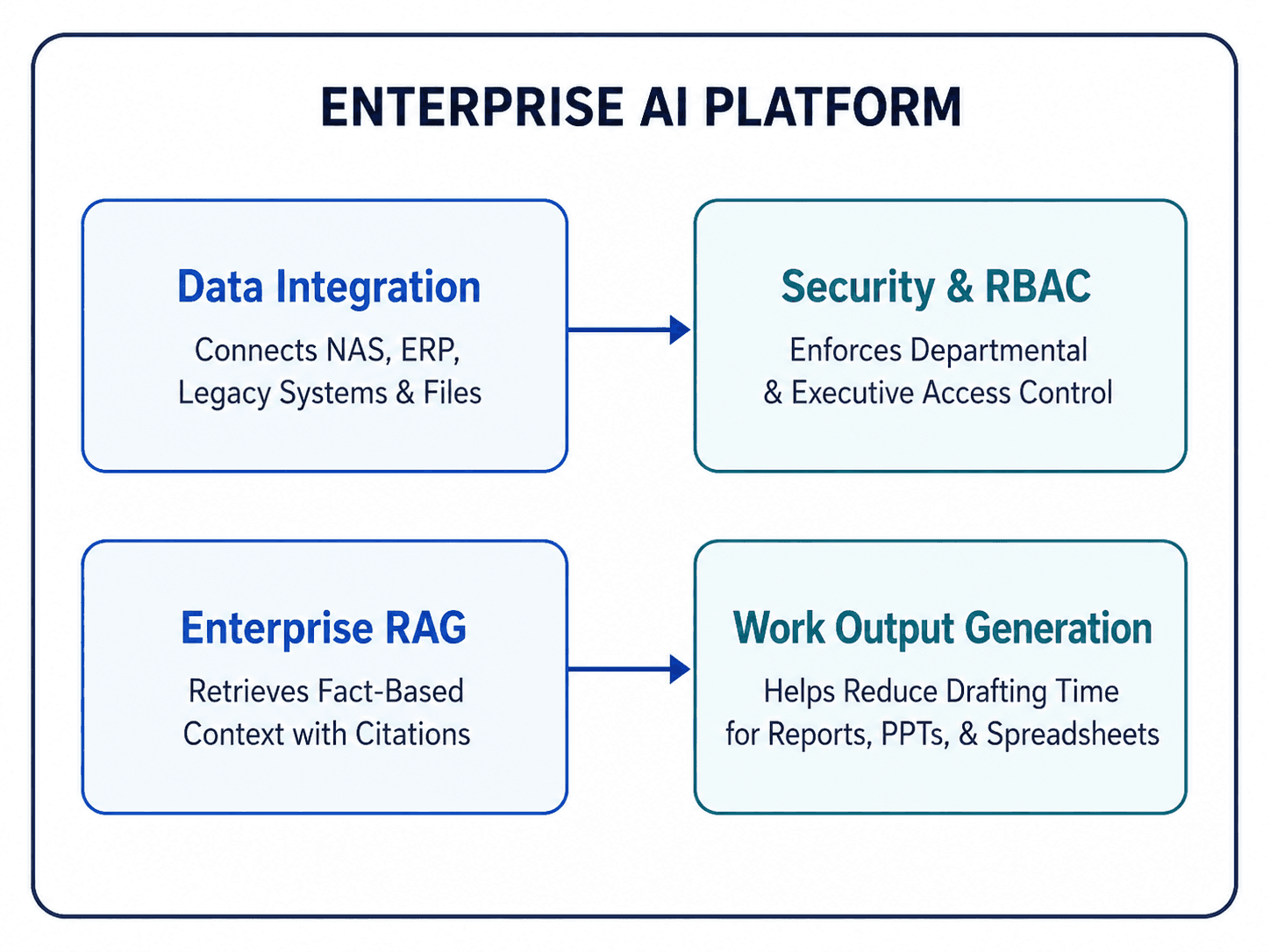
2-1. Core Architecture Pillars:
-
Unified Data Integration: Connects structured and unstructured data sources-including PDFs, Word documents, Excel spreadsheets, scanned images, and internal file servers.
-
Role-Based Access Control (RBAC) & Governance: Designed to mirror existing corporate permission structures, helping ensure employees only receive answers based on data they are authorized to view.
-
Enterprise Retrieval-Augmented Generation (RAG): Helps reduce hallucination risk by grounding responses in verified internal documents, accompanied by source citations.
-
Work AI & Deliverable Support: Helps reduce manual drafting time for repetitive business documents by assisting in the creation of formatted reports, presentation outlines, and data summaries.
-
Architecture Comparison: Cloud, On-Premise, and Hybrid AI
Selecting the right deployment model depends on your organization's regulatory burden, existing IT infrastructure, and data sensitivity.
<table><tbody><tr><td><p dir="ltr"><strong>Deployment Model</strong></p></td><td><p dir="ltr"><strong>Cloud AI</strong></p></td><td><p dir="ltr"><strong>On-Premise AI</strong></p></td><td><p dir="ltr"><strong>Hybrid AI Platform</strong></p></td></tr><tr><td><p dir="ltr"><strong>Operational Mechanism</strong></p></td><td><p dir="ltr">Multi-tenant public cloud infrastructure</p></td><td><p dir="ltr">Isolated internal servers / private data center</p></td><td><p dir="ltr">Sensitive data stays on-premise; selected tasks utilize cloud</p></td></tr><tr><td><p dir="ltr"><strong>Primary Advantages</strong></p></td><td><p dir="ltr">Fast setup, lower initial infrastructure CapEx</p></td><td><p dir="ltr">High data control, suitable for air-gapped environments</p></td><td><p dir="ltr">Balanced security, scalability, and resource allocation</p></td></tr><tr><td><p dir="ltr"><strong>Key Considerations</strong></p></td><td><p dir="ltr">Data external transfer policy review required</p></td><td><p dir="ltr">Requires dedicated hardware investment & maintenance</p></td><td><p dir="ltr">Requires clear network & data security architecture</p></td></tr><tr><td><p dir="ltr"><strong>Best Fit For</strong></p></td><td><p dir="ltr">Agile business units, general SaaS workflows</p></td><td><p dir="ltr">Finance, Public Sector, Manufacturing, Defense</p></td><td><p dir="ltr">Organizations managing both internal and cloud systems</p></td></tr></tbody></table>-
Key Criteria for Choosing the Right Enterprise AI Platform
Before selecting a vendor or building an internal solution, evaluate your options against these four practical benchmarks:
4-1. Data Connectivity Scope
Does the platform connect to local file storage, legacy NAS, and on-premise ERPs, or does it require manual data migration to external cloud storage?
4-2. Privacy & Data Governance Controls
Does the platform provide controls designed to keep proprietary enterprise inputs from being used for public model training?
4-3. Granular Permission Management
Can the platform align with existing Active Directory, LDAP, or document permission layers so restricted documents remain protected?
4-4. Support for Actual Work Deliverables (Work AI)
Does the platform only offer conversational answers, or can it help draft structured business outputs like reports, presentation outlines, and data summaries?
-
Next-Gen Enterprise Work AI: Wissly
is an enterprise Work AI platform engineered to help organizations address data fragmentation and operational security requirements across corporate environments.
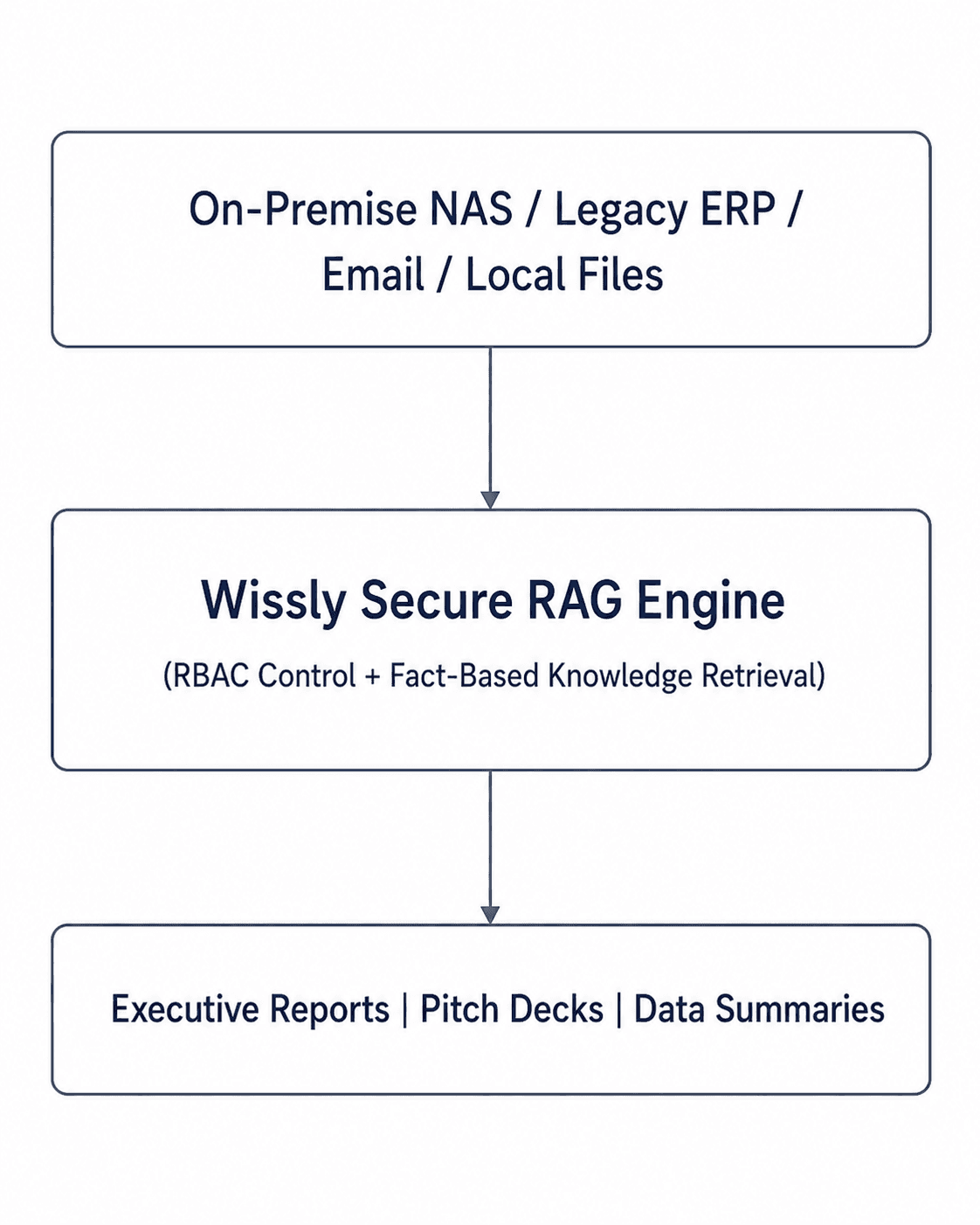
Why Enterprises Consider Wissly:
-
Broad Data Source Connectivity: Designed to connect with local storage, legacy NAS, email environments, ERPs, and internal file repositories where critical business knowledge resides.
-
Flexible Security Architectures: Offers deployment options-including On-Premise, Private Cloud, and Hybrid configurations-to support corporate governance policies.
-
Work Output Focus: Assists teams in moving beyond simple Q&A by supporting the creation of structured business reports, executive summaries, and presentation outlines based on internal documents.
6. Conclusion: AI Adoption Is About Business Impact, Not Just Technology
Successfully adopting enterprise AI is not just about subscribing to a foundation model or deploying compute capacity.
The essential question for enterprise leaders is:
"Does this system help reduce repetitive manual work and support business workflows while respecting enterprise security?"
If your organization aims to connect data stored across file systems and transform document archives into practical workflow support, offers a structured, enterprise-ready path forward.
Frequently Asked Questions (FAQ)
-
Q1. How does an Enterprise AI Platform align with internal DRM and security policies?
-
Enterprise-grade platforms are typically designed to integrate with existing corporate identity systems (such as Active Directory, LDAP, or SSO). They support RBAC configurations so users only search and retrieve information from documents they have permission to access.
-
Q2. Is a dedicated data engineering team required to deploy an Enterprise AI Platform?
-
Not necessarily. Internal IT involvement is usually required for data access setup, security policy definition, and integration scope, but platforms like Wissly can reduce the need to build ingestion pipelines and RAG workflows from scratch.
-
Q3. Can the platform index and search large files or legacy NAS repositories?
-
Yes, depending on the customer environment and document scale. Hybrid RAG architectures can index large unstructured documents across NAS drives and support semantic retrieval and contextual summarization.
-
Q4. How does an Enterprise AI Platform differ from a standard consumer chatbot?
-
A standard chatbot generally relies on public web knowledge or direct user-provided text without enterprise integration. An Enterprise AI Platform operates within a company's defined security boundaries, integrating internal data sources, applying access controls, and supporting enterprise workflows.
-
Want to know which Enterprise AI architecture fits your data environment?
-
Explore how Wissly can connect internal data, enforce RBAC, and turn search into business deliverables.
[[Find Your Enterprise AI Architecture with Wissly →]
](/en)Related Articles
-
"Where Is Last Quarter's Campaign Report?"
-
"Did the PTO Policy Change Again?"
-
"Are These ERP Revenue Numbers Accurate?"
-
"Has Anyone Solved This Error Before?"


