
Insight
What Is a Knowledge Graph? — A Complete Understanding of Its Definition, Mechanisms, and Strategic Value
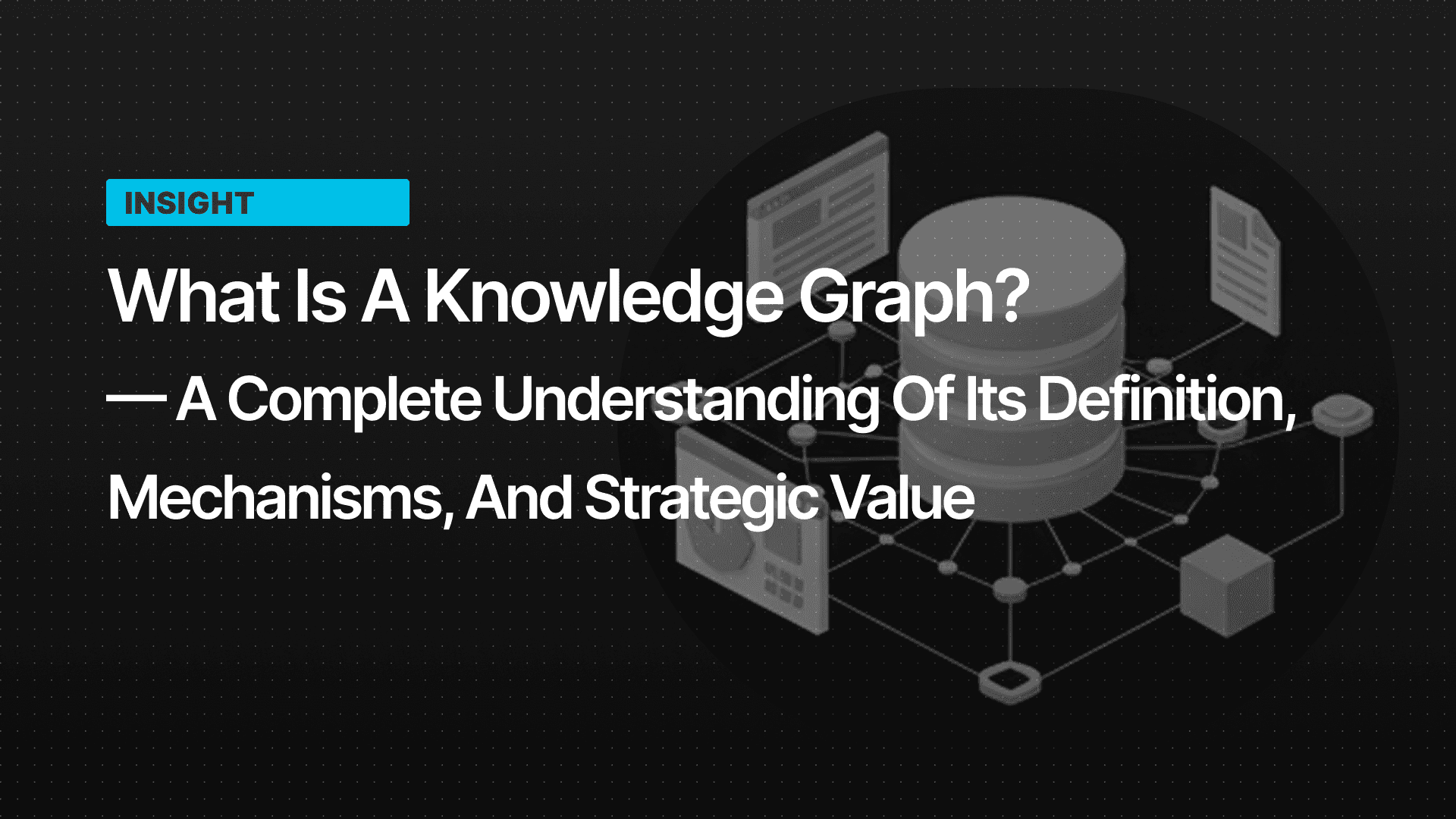

A knowledge graph is more than a data technology; it is an infrastructure that meaningfully connects the vast amount of information held by modern enterprises and institutions. By weaving data into a semantic network, it redefines how organizations structure and use knowledge. This document explains, in natural and expanded paragraphs, what a knowledge graph is, why it is essential, how it operates, the value it offers in real-world scenarios, and what strategic significance it holds for Wissly.
🧠 What Is a Knowledge Graph?
A knowledge graph represents real-world entities—such as objects, concepts, events, people, documents, organizations, and locations—and expresses how these entities are related through a graph structure. Each entity is represented as a node, and the relationship between entities is expressed as an edge. Unlike conventional data storage methods, this structure assigns context and meaning to information, making it possible to organize knowledge in a way that closely resembles how humans understand and navigate information.
Knowledge graphs typically rely on a triple structure—Subject, Predicate, Object—to represent facts. For example, “Person A — works_at → Company B” or “Company B — located_in → City C.” Each node and relationship carries metadata, such as types and properties, enabling a rich semantic structure. In other words, a knowledge graph transforms raw data into a machine-understandable and meaningfully interconnected knowledge system.
Why Are Knowledge Graphs Necessary?
Organizations today accumulate large amounts of information across many systems, departments, and document repositories. However, this information often remains isolated, trapped within separate storage systems, making it difficult to use as a unified body of organizational knowledge. Knowledge graphs address this challenge by structurally expressing complex relationships, integrating data from diverse sources, and flexibly reflecting changes in the domain.
Traditional relational databases struggle with representing many-to-many relationships or expressing the semantic links found in unstructured data. Knowledge graphs, by contrast, model complex relationships naturally using nodes and edges. They can also integrate internal data with external sources such as news, reports, and open knowledge bases like Wikidata, creating a deeper and more comprehensive network of knowledge. Because industries and regulatory environments change constantly, knowledge graphs offer a major advantage: they allow organizations to adapt by simply extending a schema or adding new nodes and relationships. This makes them an effective, long-term infrastructure for enterprise-wide knowledge management.
How Does a Knowledge Graph Work?
A knowledge graph is not merely a method for linking data. It is a structural knowledge system that enables semantic representation and intelligent exploration of information. The process begins with gathering data from internal documents, policies, contracts, research reports, and other sources, alongside external knowledge bases and industry datasets. This diverse information is then structured according to a schema or ontology, which provides the rules and semantic constraints that govern how entities and relationships can be defined within the graph.
NLP and machine learning techniques are then applied to extract entities from documents and analyze relationships within sentences or paragraphs. This process generates nodes and edges that integrate even unstructured text into a semantic structure. Once built, the knowledge graph supports semantic queries (such as SPARQL), complex relationship exploration, reasoning-based inference, and advanced automation capabilities like classification, recommendation, or contextual search.
Practical Value and Real-World Applications
Knowledge graphs transform an organization’s entire approach to data utilization. They help eliminate data silos by connecting information across departments and document repositories into a unified, semantically coherent knowledge base. AI systems trained on context-rich data drawn from knowledge graphs deliver higher accuracy in search, recommendation, and reasoning tasks. Knowledge graphs also allow organizations to execute complex queries that traditional databases cannot support, such as analyzing deeply interrelated regulatory requirements or exploring multi-layered connections across processes.
In compliance or risk environments, knowledge graphs can reveal hidden relationships between laws, regulations, internal policies, and contractual obligations, enabling teams to detect risks earlier. They also support automation of document processing, such as entity extraction, tagging, and summarization. As a result, knowledge graphs help organizations create sustainable, long-term knowledge assets.
They are widely used in open knowledge bases like DBpedia and Wikidata and are incorporated into enterprise systems to connect customers, products, processes, and regulations. They power recommendation systems used by platforms like Netflix and Amazon, and they help the medical, legal, and regulatory fields analyze relationships across cases, scientific findings, and statutes. Modern search engines also rely heavily on knowledge graphs to provide meaning-based search results.
The Significance of Knowledge Graphs for Wissly
When combined with Wissly, a knowledge graph becomes an enterprise-wide infrastructure that connects organizational knowledge into one coherent system. Contracts, regulations, manuals, research documents, policy materials, and even emails can be linked within a single graph, revealing relationships among documents and identifying duplication, inconsistencies, and omissions.
Wissly’s Retrieval-Augmented Generation (RAG) becomes significantly more powerful when grounded in a knowledge graph. It can perform more accurate semantic search, generate deeper and more contextually connected answers, and respond to regulatory or legal questions with a higher level of reliability. By modeling the relationships between laws, policies, and internal rules, Wissly can support advanced automation of compliance tasks such as impact analysis, regulatory tracking, and risk detection.
A knowledge graph also helps preserve organizational expertise over time, ensuring that institutional knowledge is not lost and enabling new team members to onboard quickly. When Wissly operates on top of a knowledge graph, the organization gains not just a document search tool but a full-scale Enterprise Knowledge Engine.
Conclusion: Knowledge Graphs Are the Future of Enterprise Knowledge Infrastructure
Knowledge graphs are a foundational technology for data-driven decision-making, regulatory compliance, research, and document automation. When combined with Wissly, they enable knowledge-based workflow automation, enhance compliance accuracy, improve document understanding, and ultimately give organizations lasting competitive advantage in how they store, manage, and apply knowledge.
Recommended Content