
A New Paradigm for Document Automation with Agentic Document Extraction

Why Are We Still Struggling with Documents?
Enterprise systems continue to become more sophisticated every year.
Yet document processing—ironically one of the most critical parts of business operations—often remains stuck in the past.
Contracts, financial statements, insurance claims, and medical records still pile up as PDFs or scanned images. And despite advances elsewhere, the way we handle these documents hasn’t changed much.
Even organizations that have “automated” document workflows often see little real improvement.
Text is extracted with OCR, manually reviewed by humans, and the moment a table becomes even slightly complex, data is copied into spreadsheets by hand.
In practice, most teams are still operating in a state where
automation exists, but human intervention is required at every step.
The root cause isn’t simply a lack of better technology.
It’s that we’re fundamentally approaching documents the wrong way.
What OCR and Traditional AI Miss
OCR treats a document as a single image and focuses on recognizing characters within it.
While this works for extracting raw text, much of the document’s original structure and context is lost in the process.
Tables lose their row and column relationships.
Checkboxes become plain strings.
And crucial signals—why a number matters or what it’s related to—disappear entirely.
More recently, many teams have started experimenting with large language models for document processing. But this approach also has limitations. Most LLMs consume documents as blocks of text, which makes it difficult for them to fully understand layout or visual structure.
As a result, structurally important elements like tables and forms remain fragile and error-prone.
Ultimately, OCR and LLM-based approaches share the same assumption:
they treat documents as nothing more than text.
Rethinking Document Understanding: Agentic Document Extraction
Agentic Document Extraction starts from a different premise.
Instead of viewing documents as text files, it treats them as data objects that carry both structure and meaning.
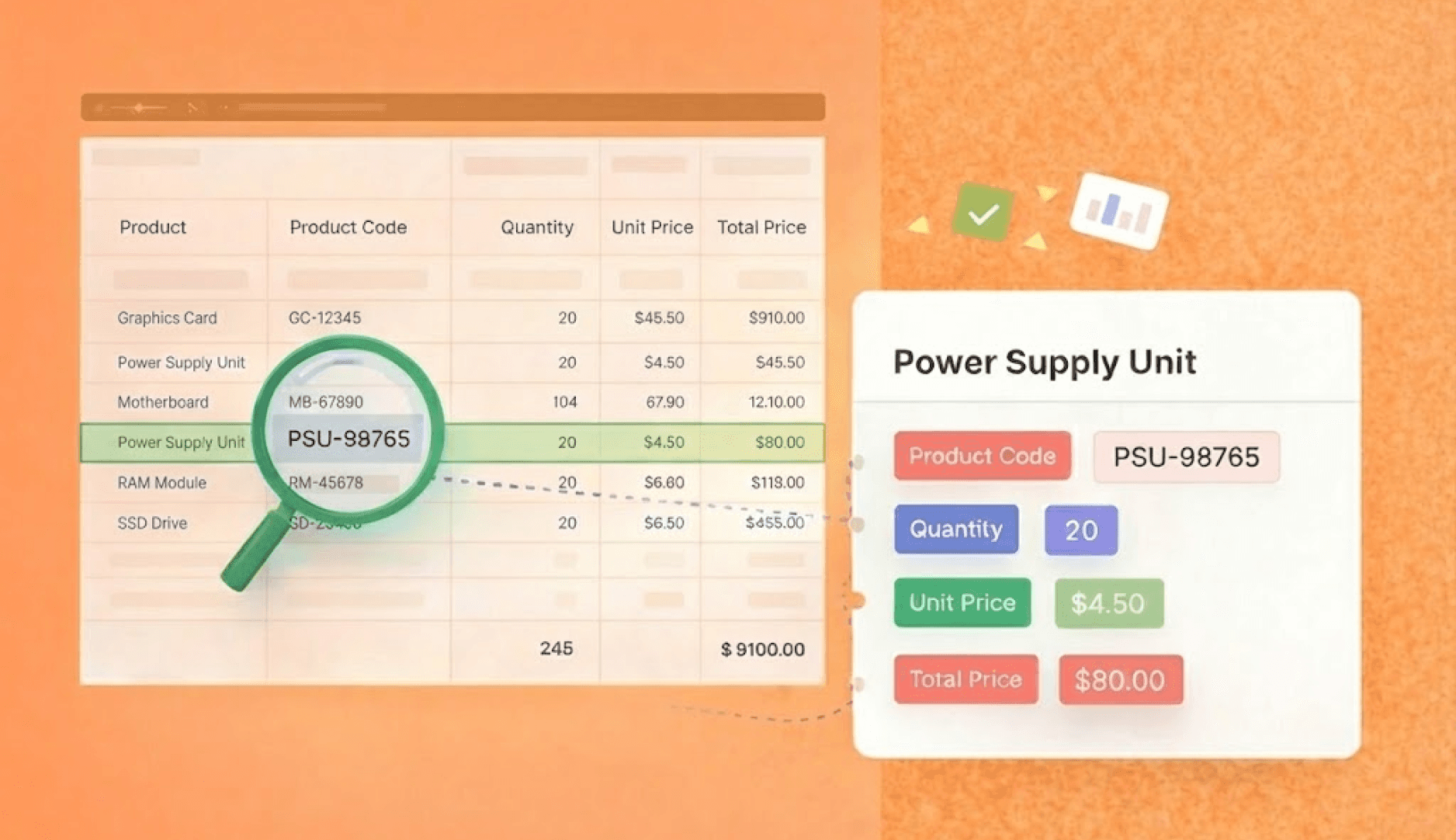
In this approach, the system doesn’t just read what’s written on the page.
As it interprets a document, it actively asks questions such as:
What type of document is this?
Which information actually matters?
How are tables, fields, and sections related?
How will the extracted data be used downstream?
Based on these judgments, the system extracts data and validates it at the same time.
When appropriate, the results can flow directly into the next step of a business process.
This is why the approach is called agentic—the system doesn’t just extract information, it reasons about it and acts on it.
When Documents Become Data
The most significant difference between Agentic Document Extraction and traditional approaches lies in the output.
The result is no longer a flat text file.
Tables remain tables.
Form fields retain their meaning and structure.
Extracted values are linked back to their exact locations in the source document.
At this point, a document is no longer something you read and discard.
It becomes a reliable data source that can be used immediately for analytics and automation.
This distinction becomes especially clear in real-world workflows.
How Workflows Fundamentally Change
Once this approach is introduced, document-driven workflows begin to change from the very first step.
Document classification requires far less manual effort.
The system identifies document types based on layout and key fields, and this understanding improves continuously over time.
Issues around table extraction are significantly reduced.
Even complex financial tables or multi-page layouts are extracted with their structure intact, eliminating much of the manual cleanup that used to happen downstream.
Another major shift is when analysis begins.
Instead of extracting data first and transforming it later, teams can immediately move into summarization, comparison, and trend analysis as soon as extraction is complete.
From a compliance perspective, the impact is just as meaningful.
Validation becomes part of the extraction process itself, rather than a separate after-the-fact review. Rule violations and anomalies are caught early, reducing the risk of errors propagating downstream.
What This Looks Like in Practice
These benefits aren’t limited to a single industry.
In fact, the more documents an organization handles, the more pronounced the impact becomes.
In finance and insurance, large volumes of financial statements and claims can be processed faster and with greater accuracy.
In healthcare, patient intake and medical record management become far more streamlined.
In real estate and energy, contract analysis and regulatory review stop being operational bottlenecks.
Here’s a snapshot of how Agentic Document Extraction is applied across industries:
Industry | Example Use Cases |
|---|---|
Financial Services | Automatic extraction of key metrics from financial documents and reports More accurate risk assessment across insurance and lending workflows |
Real Estate | Structural analysis of contracts and lease agreements Automatic identification of legally and compliance-critical clauses |
Healthcare | Automated organization of intake forms and medical records Structured extraction of lab results and histories to reduce billing errors |
Logistics | Extraction of shipment data from customs and shipping documents Improved operational visibility across warehouse and transport workflows |
Across all these cases, the outcome is consistent:
less time spent processing documents, and more time focused on judgment and decision-making.
How This Differs from OCR or GPT-Based Approaches
OCR remains focused on text extraction.
General-purpose LLMs are useful for summarization and understanding content—but they struggle when asked to preserve structure, ensure accuracy, and provide verifiable outputs.
Agentic Document Extraction isn’t simply a replacement for these tools.
Its core value lies in unifying the entire document processing lifecycle into a single system.
Instead of stopping at “reading” a document, it connects:
understanding → structuring → integrating into business workflows.
A simplified comparison looks like this:
Dimension | Agentic Document Extraction | OCR | GPT-4o |
|---|---|---|---|
Design Focus | Structural interpretation for operational data | Text recognition from images | Natural language generation and responses |
Processing Model | Layout, structure, and semantics combined | Character-level extraction | Text-centric semantic analysis |
Structural Awareness | Preserves relationships across tables and forms | Structure lost | Limited structural understanding |
Output Reliability | Extracted data linked to source locations | No built-in verification | Source traceability is difficult |
Best Fit | Enterprise-grade document automation | Manual processing support | Analysis and summarization tasks |
The distinction is clear.
Understanding documents, Turning them into data, And connecting that data directly to workflows.
Bringing these three steps together is what defines Agentic Document Extraction.
The Next Stage of Document Automation
The goal of document automation is no longer just to reduce manual effort.
We’re moving toward systems where documents can interpret themselves, validate their own data, and integrate naturally into business operations.
Agentic Document Extraction represents a critical shift—from treating documents as operational overhead to recognizing them as trusted, high-value assets within modern enterprise systems.
Recommended Content