
Insight
How Document AI Transforms Unstructured Data into Strategic Assets: A Comparison with Traditional OCR

80% of Data: Why Are We Still Failing to Utilize It?
More than 80% of modern enterprise data exists in unstructured formats such as emails, reports, and scan images. For most companies, this remains "dead data." Transforming these decades of records into business assets requires Document AI, a technology that understands context where OCR merely sees characters.
Why Document AI Now?
Structured data in ERP systems only tells half the story. The "full context" of process risks is often hidden within thousands of PDFs. Document AI is the "final puzzle piece" of Digital Transformation (DX), enabling machines to comprehend meaning rather than just performing keyword searches.
Concept: What Are OCR and Document AI?
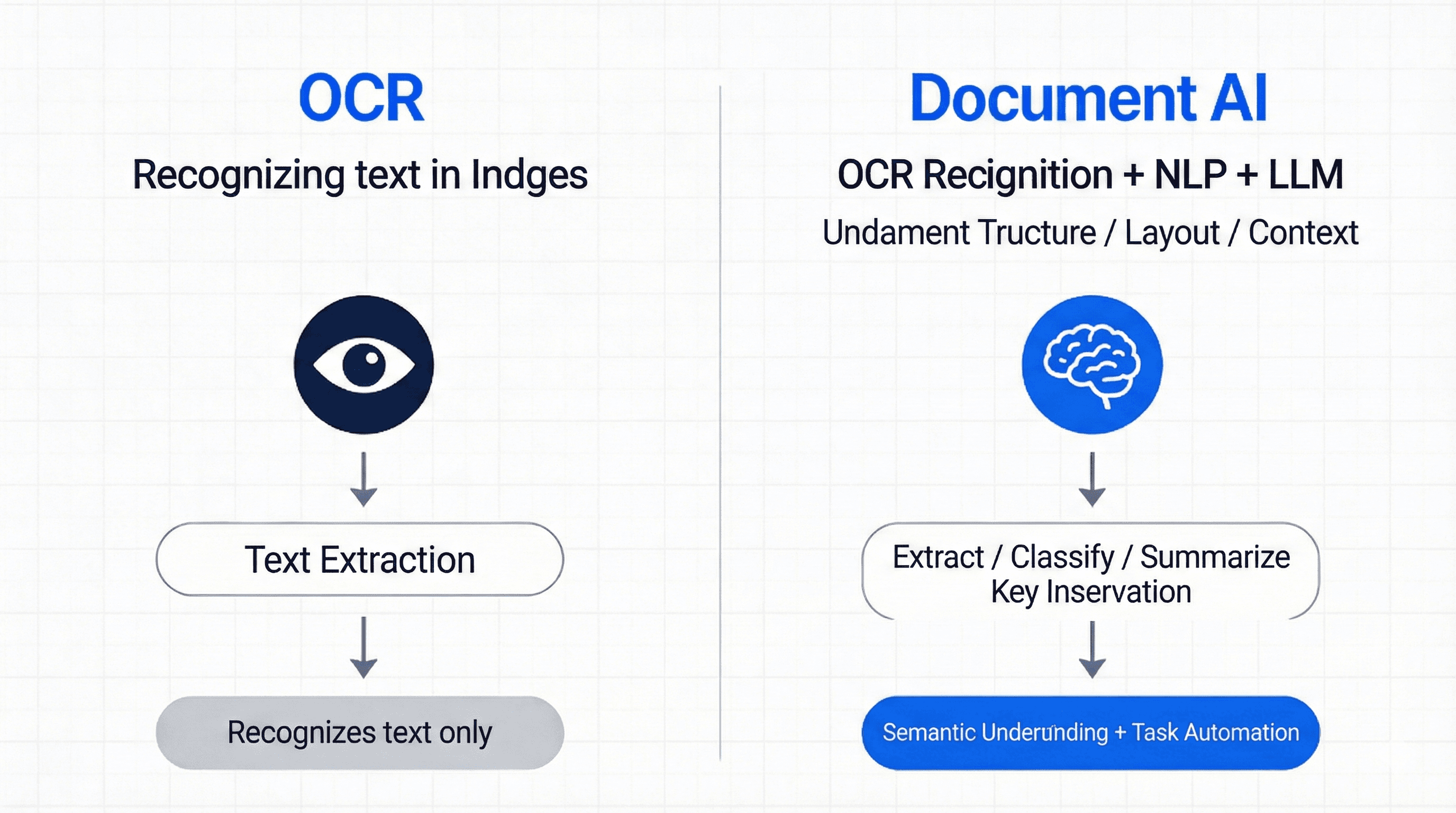
Understanding the technical distinction is the first step toward successful implementation.
2-1. OCR (Optical Character Recognition)
OCR is the "eyes that read." It extracts text from images but cannot distinguish if a number is a "unit price" or a "serial number."
2-2. Document AI (Intelligent Document Processing)
Document AI is the "brain that understands." Powered by Natural Language Processing (NLP) and Large Language Models (LLM), it identifies layouts and relationships, allowing for automated classification and summarization.
2-3. OCR vs. Document AI: A Quick Comparison
Category | OCR | Document AI |
Objective | Image-to-Text Conversion | Understanding & Data Assetization |
Intelligence | Character Recognition Only | Context & Relationship Aware |
Target Data | Structured (Invoices, Receipts) | Unstructured (SOPs, Reports, Logs) |
Automation | High Manual Post-Processing | End-to-End Workflow Automation |
From "Recognition" to "Understanding"
Document AI removes the manual bottleneck of data re-entry and re-classification.
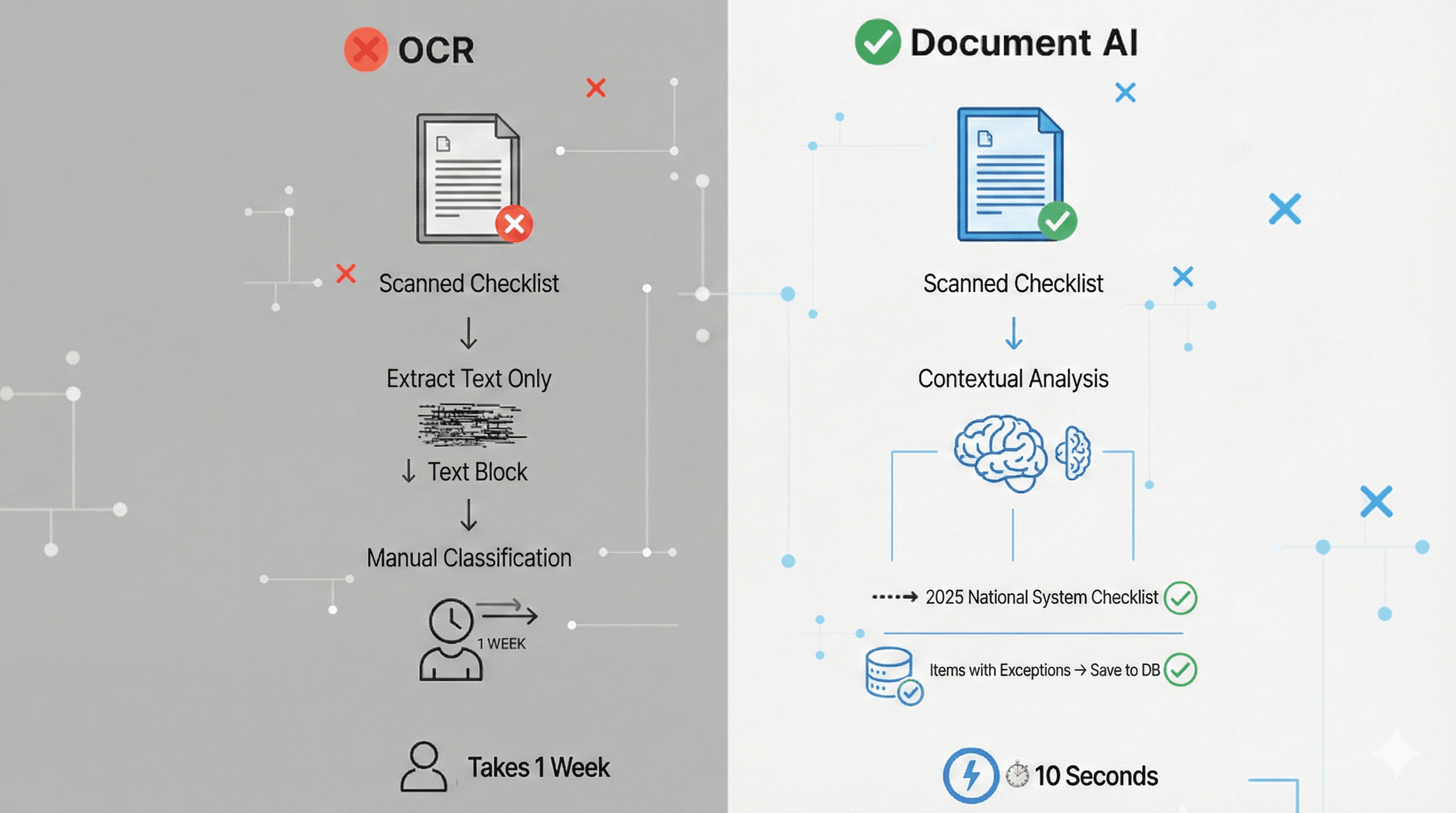
3-1. Context-Aware Data Classification
Document AI classifies files like "2025 Electrode Inspection Sheets" automatically by analyzing titles and signatures, maintaining an organized version history without human intervention.
3-2. Intelligent Information Extraction
It filters "anomalous data" from massive datasets. For example: "Find all maintenance logs where vibration levels exceeded 5mm/s." Document AI delivers the answer instantly.
Innovation in Industrial Fields: Bridging the Knowledge Gap
Manufacturing leaders are adopting Document AI to solve the "Knowledge Gap" caused by retiring experts.
4-1. Assetizing Unstructured Data
Fragmented logs and legacy PDFs are converted into a searchable Knowledge Asset. New hires can recover a decade of expertise in seconds.
4-2. Intelligent Process Auditing
AI cross-checks contradictions between documents—verifying if a "Process Change Log" aligns with the "Standard Operating Procedure (SOP)" to prevent human error.
💡 Case Study: Preventing Factory Shutdowns
When a key manager resigned, Company A faced a critical equipment anomaly. Using Wissly Document AI, the team summarized 3 years of similar cases from 3,000+ PDFs in 10 seconds, identifying the solution and avoiding a line stoppage.
Key Technologies for Success: RAG and Security
For enterprise-grade reliability, two technologies are non-negotiable:
5-1. Evidence-Based Answers (RAG Technology)
To eliminate AI "hallucinations," Retrieval-Augmented Generation (RAG) ensures the AI only answers based on your actual documents. It provides the "page and line number" for every response, allowing for human verification.
5-2. Enterprise Security (On-premise)
To protect core recipes and blueprints, Document AI should operate in an On-premise environment. This ensures all data and vectors remain within your internal infrastructure, safe from external leaks.
[Conclusion] Let Your Documents Work for You
Storing documents as "digital files" is a 20th-century approach. In the AI era, you must transform them into "Intelligent Assets." Wissly is the next-generation solution that finds answers hidden in thousands of pages in seconds. Stop searching through folders and start asking your data.
Recommended Content