Insight
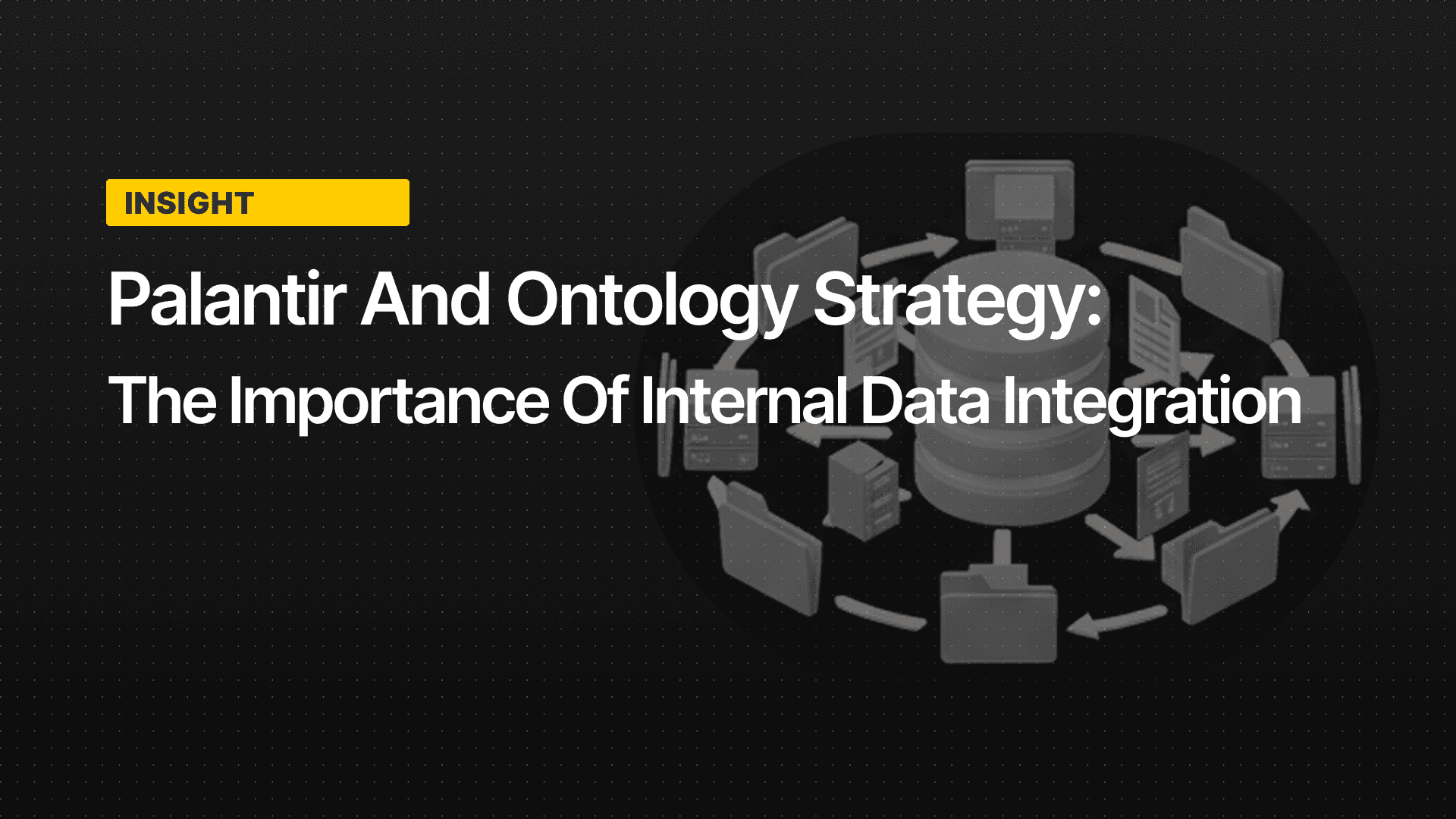
Palantir and Ontology Strategy: The Importance of Internal Data Integration
Dec 18, 2025

How Was Palantir Able to Grow?
I believe the core reason lies in internal data.
Every decision an organization makes ultimately depends on how effectively it can leverage the vast amount of internal data it already possesses.
In this post, we explore the importance of ontology and internal data integration through the case of Palantir.
Why Is Internal Data Integration Always So Difficult?
Most companies already have more than enough data.
Documents, ERP systems, CRM platforms, logistics systems, financial systems, and operational tools continuously generate data across every department.
The problem is that this data exists in isolation.
The same customer has different IDs across systems
The same product is defined differently by different teams
The same metric is interpreted in different ways
In this environment, more data does not lead to better decisions. Instead, decision-making becomes slower and more complex.
In other words, the challenge of internal data integration is not merely a technical problem, but fundamentally a structural one.
Palantir’s Approach: Ontology
To address this challenge, Palantir positioned itself not as a simple data integration platform, but as an ontology-driven system.
At its core, an ontology is a shared language that defines how an organization understands the world it operates in.
Palantir’s ontology includes:
Objects the organization works with
Relationships between those objects
Actions and context used in real operational workflows
What matters most is that this ontology is not owned solely by IT.
It is a structure shared and used by frontline teams and decision-makers alike.
Connecting Data Is Not Enough — You Must Connect Reality
Traditional data integration focuses on bringing different datasets into one place.
Palantir’s approach, by contrast, focuses on modeling reality itself as a single, connected system.
For example:
Logistics data
Financial data
Operational data
Instead of existing separately, these are designed to flow together as:
one order → one supply chain → one decision-making process
As a result, decision-makers no longer need to rely on complex SQL queries or fragmented reports. They can immediately understand what is happening right now.
The Real Impact of Internal Data Integration
The outcomes of Palantir’s ontology strategy are straightforward:
Faster access to data
Reduced interpretation gaps between departments
Shorter decision-making lead times
But beneath all of this lies a consistent foundation:
a shared definition and connection of internal data.
The goal of data integration is not to see more data —
it is to ensure everyone sees the same reality.
Why This Strategy Matters
No matter how advanced AI, analytics, or automation become, their impact will always be limited if internal data remains fragmented.
Palantir’s case makes this clear:
Before technology, organizations must define data meaning
Before systems, organizations must agree on a shared language
Ontology is both the starting point and the core strategy for meaningful internal data integration.
After Palantir: Connecting the Dots with Wissly
What Palantir’s ontology strategy ultimately shows is that internal data integration begins not with technology, but with structuring meaning and context.
Wissly takes a similar perspective by focusing on connecting scattered information and knowledge directly into everyday workflows and decision-making processes.
The approaches may differ, but the underlying question is the same:
How can organizations transform what they already have into something truly usable?
Why not start today by making the vast collection of internal documents in your company easier to find, understand, and use?
Recommended Content