Insight
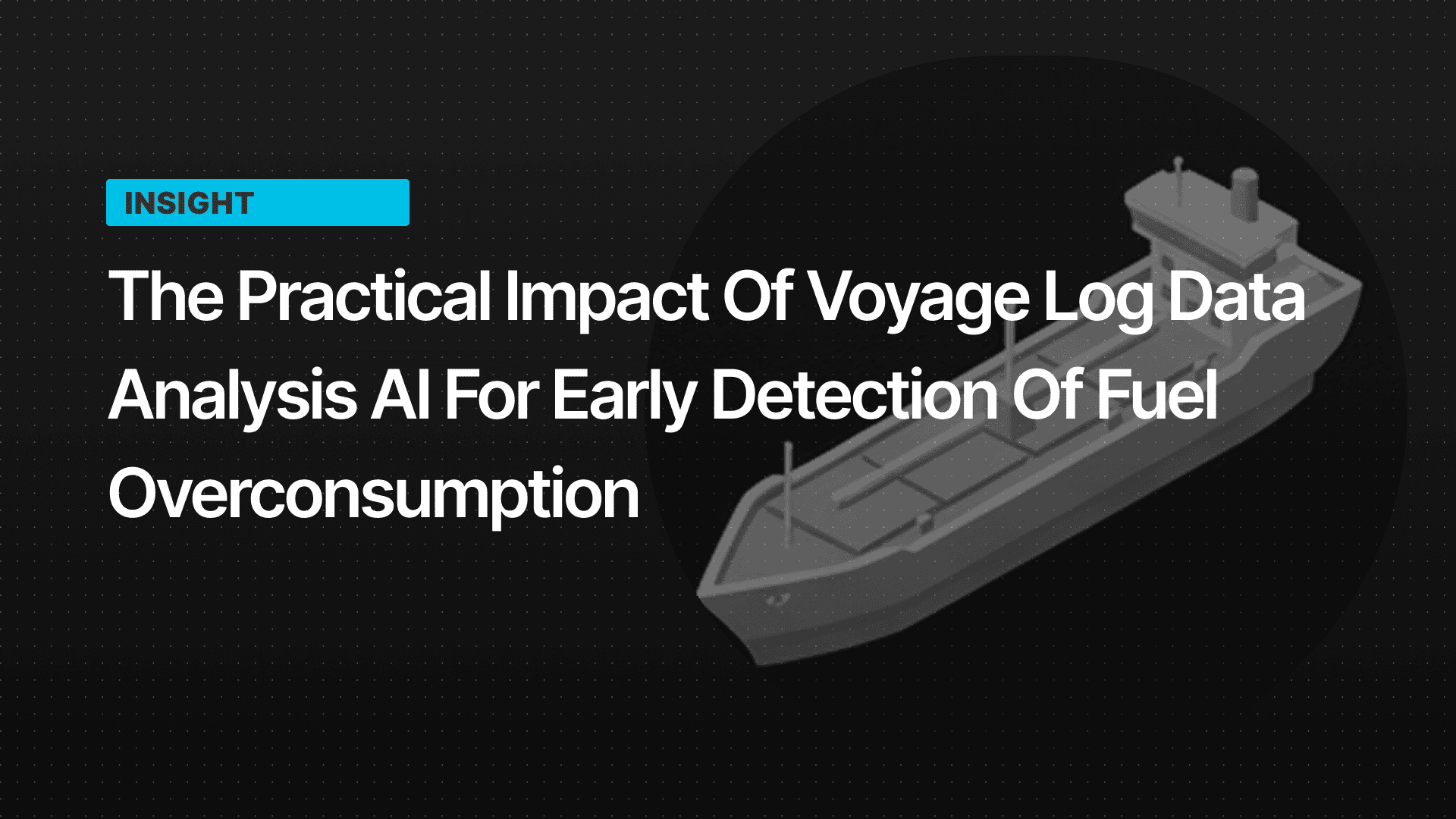
The Practical Impact of Voyage Log Data Analysis AI for Early Detection of Fuel Overconsumption
Dec 22, 2025

A shipping company’s day runs on numbers and logs. Noon Reports, Engine Logs, AIS/ECDIS tracks, weather and sea state, shaft torque and flow meters, even crew notes—data grows exponentially as voyages accumulate. But what the front line actually needs is not the data itself; it is a summary that reads the fuel‑ and performance‑critical signals in time and turns them into action immediately. This article organizes, for operations teams and superintendents, technical teams in charge of fleet performance and fuel efficiency, and ESG groups managing CII and carbon emissions, the principles, pre‑adoption checklist, and field applications of Voyage Log Data Analysis AI. Using Ryntra as an example, we explain how to detect overconsumption earlier and speed up decision‑making without forcing a big change in the way you work.
Why Voyage Log Data Analysis Matters
The explosion of Noon Report, Engine Log, and AIS data
Even a single vessel’s daily data volume and variety are substantial. Noon Reports entered by crew summarize fuel consumption, speed, weather, and activity state. Engine Logs pile up minute‑level measurements such as RPM, load, temperatures, and pressures. AIS/ECDIS record track and speed changes, while external routing services provide wind/wave/current forecasts. Add flow meters and shaft‑torque sensors, draft and trim data, and you get signals streaming in at different resolutions, units, and time series. Collecting and interpreting all of it manually has already exceeded human capacity.
Fuel and performance risks created by after‑the‑fact analysis
Timing is the problem. If aggregation and review happen only after a voyage ends, you are reacting after overconsumption has already accumulated. If you fail to catch issues right when they emerge—hull fouling, propeller damage, sensor drift, or an inefficient speed profile—your CII grade deteriorates faster than planned and fuel loss snowballs even on the same leg. Comparing simple averages without separating rough‑weather segments from calm‑weather segments also distorts vessel‑ and voyage‑level performance comparisons. In short, late interpretation costs real money.
The gap between data → meaning → action
The same logs lead to different conclusions if the standards and context for interpretation differ. If data is not organized into meaning, meetings get longer, execution slows, and validation of effects becomes blurry. The core value of Voyage Log Analysis AI is to close this gap and present, in one flow, what is abnormal, why it likely happened, and what to do now.
Core Concepts of Voyage Log Data Analysis AI
Aligning disparate log streams to a single timeline
The first step is connection and reconciliation. Collect Noon Reports, Engine Logs, AIS, and weather feeds; normalize timestamps to UTC; and map vessel/voyage/leg keys to a common schema. Handle missing data, duplicates, and latency with rules, and auto‑correct leg segmentation so it aligns with real operations (departure, course change, slowdown, bunkering). Only then do speed, consumption, weather, and engine signals gain meaning on the same time axis, and all subsequent comparisons become apples‑to‑apples.
Interpreting speed, fuel, weather, and engine signals together
The AI reads simultaneously speed (SOG/STW), wind/wave/current, draft/trim, main‑engine RPM/load, and flow‑meter‑based consumption. To see intrinsic performance after weather normalization, it learns a normal band and separates Speed Loss (speed reduction after adjusting for weather and draft) from Overconsumption (excess fuel use relative to peer conditions). It automatically computes per‑leg EEOI‑like indicators, distance per unit fuel, and emissions per ton‑mile, then compares against class‑/route‑specific baselines to show deviations intuitively.
Naturally distinguishing normal patterns from out‑of‑band signals
On the ocean, false alarms are costly. The summarization engine therefore combines statistics (moving averages/variance) with seasonal decomposition and multivariate anomaly detection to extract meaningful deviations amid choppy noise. It looks at engine events and weather factors for the same timestamp so that temporary increases due to rough weather are excluded from alerts while repeating/accumulative anomalies are raised as “watch” signals. Alerts remain restrained, and the front line builds trust without fatigue.
Basics of the data pipeline and architecture
Design the pipeline—onboard collection → satellite/cellular transmission → onshore reconciliation → feature generation → summarization/alerts—to be shallow and simple. Ryntra supports summary‑first transmission and buffered re‑send to respect bandwidth limits, and uses caching so the on‑board view holds even during link loss. Store raw logs (cold) separately from features/aggregates (hot) to balance cost and speed.
Practical Changes Driven by Automation
Early recognition of fuel overconsumption and performance decline
If consumption spikes in calm weather, the system immediately presents a priority check list—trim optimization, hull/prop fouling, sensor calibration. Actions accelerate along the chain of first look → quick inspection → parameter adjustment, and results are tagged to build evidence for future decisions in similar cases. The key is to build a rhythm of see early, move early.
Making vessel‑ and voyage‑level performance comparison intuitive
Comparisons after adjusting for weather, draft, RPM, and other conditions enable fair performance comparisons across vessels and voyages. Build a league table within the same class/route cohort, avoid single‑metric dependence, and show confidence intervals to reduce misinterpretation. In monthly ops reviews, summarize common patterns among top and bottom segments to set priorities for improvement.
Providing a log‑based foundation to explain CII grade changes
CII calculated once at year‑end has limited managerial value. At the end of each voyage, present the estimated grade and contributing factors (weather impact, operating‑profile change, suspected performance deterioration) on a single page so that early correction and plan reset become easier. In discussions with customers and charterers, you gain grounds to explain with numbers and logs.
Cultural shift: shorter reports, discussions about causes and options
As auto‑summaries settle in, less time is spent reading tables and charts in meetings, and more time is allocated to root‑cause hypotheses, DOE plans, and execution‑risk discussions. Ryntra provides persona‑specific cards tailored for executives, operations, technical, and ESG so the same facts are shown at the right depth for each audience.
Characteristics of Ryntra‑Based Log Analysis (deliberately abstract and non‑specific)
A flexible sense for organizing flows in vast logs
Ryntra does not break the flow even when tools and formats differ. Scattered records resolve into one rhythm, and important signals naturally come to the front. Teams can discuss from the same screen without major changes to their habits.
Balanced judgment that surfaces anomalies without excess
Considering ocean variability, Ryntra favors quiet but clear alerts. It suppresses unnecessary notifications and adds context only when you truly need to know. Depth adjusts by recipient, time, and channel to minimize fatigue.
A summary structure that operations, engineering, and ESG can all read together
Before a meeting: one line. On deck: a checklist. For management: a bundle of cards. Ryntra presents the same facts in different views by audience and situation, enabling operations, technical, and ESG to reach fast consensus in a shared language.
Security and distribution: pragmatic on‑prem/hybrid choices
Fuel/performance logs often include sensitive information. Ryntra supports on‑premises or hybrid deployment to maintain the security perimeter while providing essential integrations. Role‑based access, change history, and audit trails are built‑in to satisfy IT/security requirements.
Pre‑Adoption Checklist
Define the scope of logs to analyze (Noon, Engine, AIS, etc.)
Set your standard scope of logs and document each source’s collection cadence, accuracy, and retention policy. To start, the three pillars—Noon, Engine, and AIS—are enough to confirm impact. Consider flow meters, torque, draft, and trim as a phase‑two expansion.
Establish comparison standards at the vessel/voyage level
Standardize vessel/voyage/leg keys, and agree on weather‑normalization rules and draft/RPM adjustments. Compare within cohorts (class/route/season) and present results with confidence intervals. Speak in terms of deviation under the same conditions, not “good/bad,” to raise field acceptance.
Link analysis results to fuel‑saving and performance‑improvement actions
Document the loop detect → confirm → act → verify and make RACI and lead times explicit. Define per‑action checklists and pre‑approval criteria (hull cleaning, trim optimization, speed‑profile adjustment) so alerts translate directly into execution.
Data‑quality control and time synchronization
Sensor offsets, stuck values, and missing segments distort interpretation. Make standard NTP/GPS time sync, sampling‑rate checks, and unit/format standardization regular audit items. Ryntra displays data‑quality badges to show report trustworthiness.
Field Application Scenarios
Early detection of overconsumption patterns during a voyage
With real‑time or daily sync, once overconsumption is detected mid‑voyage, Ryntra immediately proposes suspected causes and first actions (e.g., adjust trim by +0.3 m, quick inspection, re‑calibrate flow meter). Tagged outcomes speed decisions in the next similar situation. Early detection cuts fuel use and also reduces unexpected arrival delays.
Summarizing fleet performance variance to tune operating strategy
Summaries of performance distributions by vessel and route—and of common characteristics in the top/bottom segments—let you adjust operating strategy (speed profile, route choice, maintenance schedule) on evidence. Timing for hull cleaning and priority for propeller polishing become data‑driven.
Automatically assembling log‑based explanation packs for CII response
Each month, compile a one‑pager with estimated CII grade, risks, and improvement headroom for ESG reports and charterer communication. Ryntra provides a one‑click package bundling log snippets, charts, and supporting links to shorten explanation time.
Case snapshots
Case A: Persistent overconsumption even after weather normalization → trim adjustment + hull cleaning reduced average voyage consumption by 4%.
Case B: Repeated speed degradation on the same route with similar draft → suspected propeller fouling; after polishing, Speed Loss improved by 1.2 knots.
Case C: Sensor drift detected → flow‑meter re‑calibration removed false alerts and raised trust in notifications.
Alert Policy and Sensitivity Tuning
Balance precision and recall. Start wide (high recall) and reduce over‑alerts with two to three weeks of live feedback. Layer thresholds by class/route/season, apply de‑duplication and quiet hours to lower crew fatigue, and route by persona (email/messenger/dashboard) to minimize noise. Ryntra supports these patterns out of the box.
Deployment Roadmap (4‑Week Pilot Recommended)
Week 1: Wire data (Noon, Engine, AIS), standardize keys/units, stand up a basic dashboard.
Week 2: Weather normalization and normal‑band learning; initial alert policy; review week‑one results.
Week 3: Cohort comparisons and league tables; case tagging; linking actions to results.
Week 4: Threshold tuning; refining alert policies; finalize executive report template; agree on scale‑up plan.
Performance Measurement and Validation Framework
You need a baseline to prove savings. Pair legs with similar route/season/draft conditions and use before‑after (A/B) or synthetic control. Track five core KPIs: (1) distance per unit fuel by voyage, (2) Speed Loss improvement, (3) shorter action lead time, (4) alert precision, and (5) CII‑grade trend. Ryntra provides automatic lift calculations with confidence intervals.
Conclusion: The Speed at Which You Read Logs Determines Fuel Efficiency
The power of analysis that reads signals before the data piles up
When collection, reconciliation, and interpretation connect in one flow, the field can see fast, explain precisely, and move immediately. Fuel burns less, arrivals stabilize, and regulatory risk declines. Speed is cost, and cost is competitiveness.
Start the proactive shift in voyage performance management with Ryntra
Start small and scale fast. Run a four‑week pilot on the three core log pillars (Noon/Engine/AIS), then expand to flow meters/torque/draft/trim. Keep reports short, execution crisp, and improvements repeatable. Ryntra will quietly support that shift.
Detect fuel overconsumption early with AI-powered voyage log analysis. Turn Noon Reports and engine logs into faster, smarter decisions.
Recommended Content